


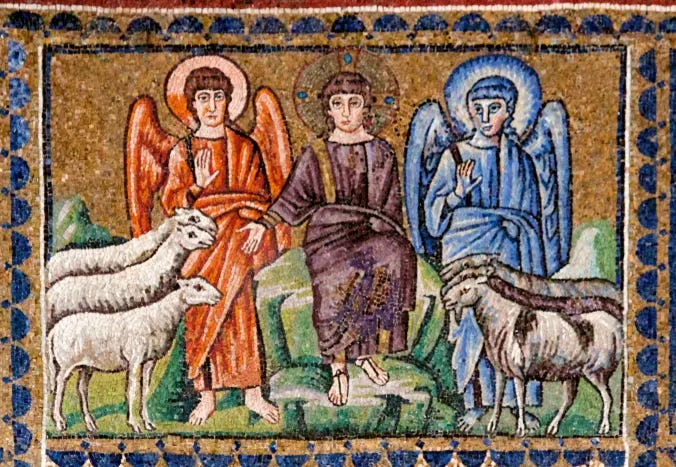
Despite preaching what feels like dozens of sermons on the scripture passage, one of the questions I most commonly receive regards Christ’s final parable before his Passion— the one about the sheep and the goats.
The audio is unedited, but below is the sermon stripped down to its exposition on the parable. And remember, it is a parable. Jesus never passed out a pamphlet on how to get to heaven or avoid everlasting torment. He instead went to a cross to take away the sins of the world, and he didn’t miss any.
If you want proof that deep-down we want the comfort of merits and demerits rather than the indiscriminate acceptance of Easter, if you want evidence that in the end we prefer the Golden Rule instead of the Gospel, you need look no further than the fact that Matthew 25 is every Methodist’s favorite parable.
The parable of the sheep and the goats is Jesus’ final parable. And, sure, this final parable sounds like it’s finally the end of Jesus’ preaching on bottomless, unconditional, no-matter-what-you-do-I-do-for-you grace. The closer he gets to his passion; it sounds like the prodigal father has run out of fatted calves and now is going to reward the rewardable. It sounds like Jesus has pivoted from gift to grades, from mercy for sinners to merit pay, from free undeserved pardon to punishment.
Grace is God’s unmerited favor.
Grace is God’s one-way love.
Grace is the melody the New Testament returns to over and over again:
“By grace you have been saved through faith, and this is not your own doing; it is the gift of God— not the result of good deeds you do— so that no one may boast about what they have done.”
But…
There seems to be a lot of earning and deserving going on here with the sheep and the goats.
As a Shepherd, this King doles out punishments and rewards based not on our faith but on our deeds alone. (We think.) The sheep fed the hungry. The sheep gave water to the thirsty. The sheep welcomed the stranger. The sheep clothed the naked. The sheep cared for the sick. The sheep visited the prisoner. The sheep did all the things you need not believe in the Good Shepherd to believe are good things; nevertheless, the Good Shepherd rewards them for the doings they did.
And the goats did not do those deeds.
And they are punished precisely for not doing them—we think.
Salvation is based not on what Christ accomplished for us (so it seems here); salvation is based on what we accomplish for Christ. The Gospel (it sounds like here) is not Christ the Lamb of God became a goat so that goats like us might be reckoned among the Father’s faithful flock. The Gospel (it sounds like here) is that you must get over your goatness and become a better sheep by doing what the Good Shepherd tells you to do. The promise (it sure sounds like here) is not that everything has already been done for you in Christ and him crucified The promise (it sure sounds like here) is that Christ is for you if you do everything for him.
Even though Jesus thus far has studiously avoided making badness an obstacle for admittance into his Kingdom and spent all of his time eating and drinking not with sheep but with goats, it sure sounds like Jesus here has scrapped the prior three years of his preaching, taken off the velvet glove of grace and now put on the brass knuckles of the Law.
“Your sins of omission—what you’ve left undone—they’re sins against me,” Jesus says.
We think.
Based on the conventional, cliched reading of this parable, even a busy flock better buckle down and pump up the volume on your good deed doing. No matter how much you’re doing, do more. Do more; so that, when you meet the Lord for your final exam, your performance review, your everlasting audit, you can say to Christ your Savior: “You gave us the course curriculum in Matthew 25—you gave us your marching orders. And we did what you said to do.”
And with our report cards and resumes in hand, with our discipleship diplomas and extracurricular accomplishments—with all our good deeds done for another—we will be able to give our valediction to Christ our Savior, “Graduate us, Lord, to what we’ve earned. Pay us what we’re owed. Give us what we deserve.”
Except—
If we said such to Christ, we wouldn’t be speaking to our Savior because he told us what to do and we did it so, really, we saved ourselves.
Let me say it again:
If Christianity boils down to doing what Christ said to do, then Christ is not a Savior, for by doing what he said to do we’ve effectively saved ourselves.
Which is sort of unfortunate because Jesus promptly goes from here to Jerusalem where he’s bound and determined to save us from our sins by dying for them.
As the angel at the gates of heaven says to the do-gooding dead guy in C.S Lewis’ The Great Divorce, “Nothing here can be bought or earned. Everything here is bleeding charity, grace, and it’s yours only by the asking.”
It’s yours by the asking.
The Bible says the Law is written not just on tablets of stone, but on every human heart too. Every single one us—we’re all hard-wired to be score-keepers and debt collectors, hellbent on turning the Golden Rule into a yard stick by which we can measure our enoughness over and against our neighbors. And because I’m just like you, I can bet what some of you are thinking right about now. Does this mean our good deed doing doesn’t matter?! Of course, what we do matters. The Paul who says that you are saved by grace through faith not good deed doing is the same Paul who tells the Philippians that “God is at work in you and through you to will and to work for his pleasure.”
So, don’t misunderstand me.
Yes, good works are important.
Yet— We’re so stubborn about shaping Jesus in our scorekeeping image, we’re so determined to turn Jesus into the Almighty Auditor from the Department of Afterlife Affairs, that we miss the embarrassingly obvious epiphany in this parable.
The big reveal behind this parable of judgment is that good godly works cannot be tallied up on a scorecard.
The good works that count for the Kingdom cannot be counted because—notice now—when the Shepherd hands out report cards neither the sheep nor the goats have any idea they’ve done what the King says they’ve done or left undone. When the King of the Nations separates them as a Shepherd one from the other, the sheep are not standing there waiting to be handed their magna cum laude for a lifetime of charitable giving and community service hours.
No.
For the sheep and the goats alike, there’s just surprise.
“When was it that we saw you hungry and gave you food?
The sheep are surprised by the grade the Good Shepherd gives them.
They’re stunned.
To use this parable to exhort members of the flock to go and do good deeds for the Shepherd is to ignore the point that the sheep are blissfully ignorant that they’ve done good deeds for the Shepherd.
“Wait, wait, wait—when did we do that?”
They’re surprised.
They’re surprised because they weren’t thinking at all about doing the good deeds they did. All their good works—the sheep did them not because they were told that’s what sheep ought to do. The sheep just did them as they were caught up in the joy of their Shepherd. The good works that count were not done to be counted; the good works that count were unpremeditated, done out of love—organically, such that the sheep weren’t even aware they’d done them.
Listen again to who was counting.
“Then those on the King’s left will answer, saying, “Lord, when did we see you hungry or thirsty or a stranger or naked or sick or in prison, and did not minister to you?’”
It’s amazing how we mishear this parable.
It’s not that the goats didn’t do any good deeds.
It’s that they felt justified in having done enough.
“We fed the hungry. We clothed the naked. We did all those things—when did we not take care of you too?”
It’s not that the goats didn’t do any good deeds. It’s that the goats come to Jesus dependent upon their good deeds. The goats think they’re good enough; meanwhile, the sheep were so in love with their Shepherd they’re stunned to hear they’ve got any good grades on their report card at all.
The danger in taking the Bible for granted is that we’re all natural-born Pharisees and so we turn the Gospel into Law without even realizing we’ve done it. We’re as stubborn as goats when it comes to this parable. We insist on hearing it in terms of reward and punishment, earning and deserving, but that contradicts the clear conclusion Christ contributes to it: “Come, you that are blessed by my Father, inherit the kingdom prepared for you from the foundation of the world...”
Notice, Jesus does not say to the sheep, “Here’s your wage. Here’s your reward.”
No, Jesus says to the sheep, “Inherit the Kingdom.”
The Kingdom is not their compensation.
The Kingdom is not their accomplishment.
The Kingdom is their inheritance.
You can’t earn an inheritance.
Not only is this parable about inheriting instead of earning, Jesus says as plain as the nose on your face that this inheritance has been prepared for the sheep from before the foundation of the world. Before God put the stars in the sky, God made this promise to you.
Think about it—
This parable isn’t about our works, good or bad, because before any of our works, good or bad, had been done, what work was God doing? Preparing a place in the Kingdom for you. For all of you. For every last one of you. How do I know?
Notice—
In the parable, the King doesn’t say to the goats what he says to the sheep. He doesn’t say to those on his left “Depart from me, you cursed ones, into the eternal fire prepared for you from the foundation of the world.”
No, he says, “Depart from me, you cursed ones, into the eternal fire prepared for the Devil and his angels.” Sure, we can get our sphincters all in a pinch over that image of eternal annihilating fire. But if this parable is about our inheritance, then the point is that the place of punishment wasn’t prepared for them!
Don’t you see—
The place where the goats are going is not a place they were ever meant to go. The place the goats go is not a place that was prepared for them. Where the goats are going, they don’t have to go.
Don’t you see—
No one is out who wasn’t already in.
Nobody is excluded from the Kingdom who wasn’t already included in the Kingdom from before the foundation of the world. The goats get themselves where they’re going by stubbornly insisting, they’re earned what can only be inherited. The goats are like the elder brother in that other parable, pouting with his arms crossed and gnashing his teeth in the outer darkness beyond the prodigal’s party. Father, I’ve worked for you all these years. I deserve that party.
In Heaven, there is nothing but forgiven sinners.
In Hell, there is nothing but forgiven sinners.
The only difference between the two is that those in Hell don’t think they deserve to be there, and those in Heaven know they don’t deserve to be there.
The goats get themselves where they’re going by stubbornly insisting, they’re earned what can only be inherited.
This parable of judgment—
There’s a third category of people here. Not just sheep. Not just goats. There’s a third flock of people in this parable. Those in need. Jesus says it bluntly: the place where his presence is promised—where there should be no surprise or speculation—is not with the good but with those in need. And so, if you’re worried about whether you’re a sheep or a goat, then your refuge should not be the work you’ve done for Christ but the work you need from him. The assurance that Jesus Christ abides with you lies not in your merits out measuring your demerits. The assurance that Jesus Christ abides with you—is for you—lies in your lack. The guarantee that you are not alone—the guarantee of God’s blessing upon you—is not your awesome list of accomplishments but your inadequacy.
Jesus puts it plain to both the sheep and the goats alike—he makes his office is at the end of your rope.
Has the treadmill of good works alone left you exhausted and starving?
Do you thirst for the kind of faith and joy you see in others?
Are you sick of all your best efforts to be a good sheep?
Or are you just sick?
Is there something in your past that leaves you feeling naked and ashamed?
Are you in a relationship locked in resentment?
Are you captive to abuse?
Or addiction?
Do you feel out place, wondering what the hell you’re even doing here?
If so, hear the good news.
In the same way you come up here with the gesture of a beggar to receive him in bread and wine, Jesus Christ is present to you in your poverty. The ticket to this Table is the only ticket you need for his Kingdom. Your need. You need only know your need.
The Kingdom is yours only by the asking.


