

“The only people to whom you will ever preach are already-forgiven sinners”
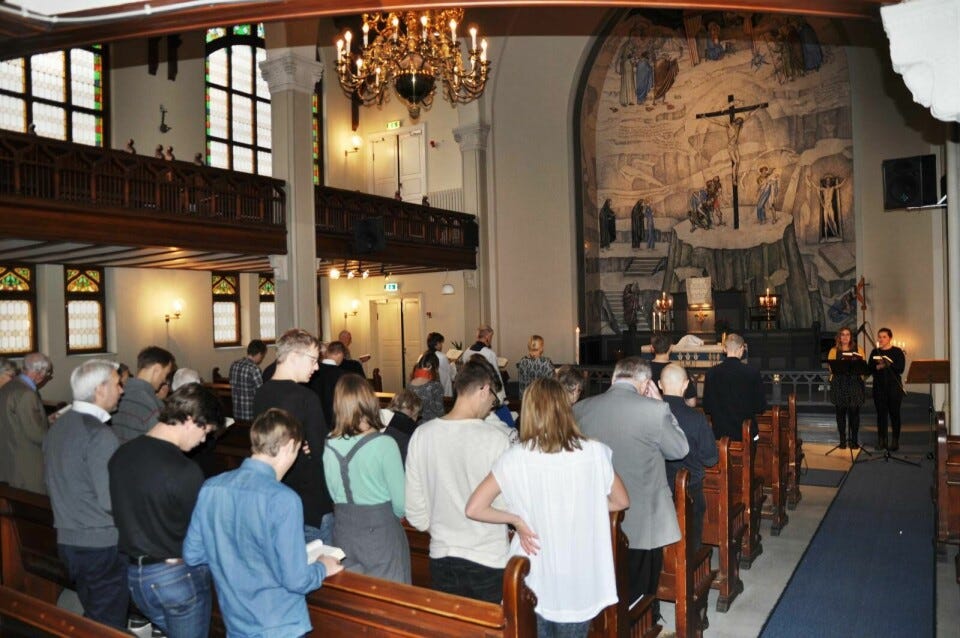
Here is my second talk at St Peter’s Kryka in Stockholm, Sweden.
+JM
Advice for Preachers in Uncertain Times
A few years ago, a young pastor reached out to me, soliciting advice on preaching in what felt then like an uncertain time in the United Methodist Church. I suspect for many preachers the times feel only all the more uncertain. I wanted to be honest with her in my reply. Jesus promises that hell will not prevail against his church; Christ made no such pledge about the specific denominations and traditions that comprise his Body and Bride. In our individual incarnations, the LORD evidently allows us to fracture, realign beyond recognition, or dwindle into institutional irrelevance. Indeed if the Triune God’s name is Jealousy and out of his jealous love he delivered his Israel into exile in Babylon, then the same LORD may be presently punishing his church in the west for her unfaithfulness during such uncertain times.
The church, I told her, will endure because the one who is its head is risen indeed and lives with death behind. Our idiosyncrasies will endure only as long as they serve the proclamation of the gospel. As Jaroslav Pelikan distinguished the matter, “tradition is the living faith of the dead, while traditionalism is the dead faith of the living.” What this novice preacher termed an “uncertain time” is in fact the dying gasps of Christianities stubbornly wed to traditionalism.
Nonetheless, having been asked, I felt bound to answer her question, “How must I preach during such an uncertain time?”
I can think of no better counsel than the counsel given by Karl Barth during his only visit to America at the end of his career in the spring of 1962. Eberhard Busch, Barth’s longtime assistant, records it in his collection of the theologian’s letters and autobiographical material. During the Q&A for the Warfield Lectures at Princeton Theological Seminary, a student asked Barth, “What one thing is necessary in this day and age not only to pastor a church but to preach the gospel to it?”
Barth replied in his typically exhaustive fashion:
“Ah, so big a question! That is the whole question of theology, you see! I should say, I hope that during your studies you have visited yourself earnestly with the message of the Old Testament and of the New Testament. And not only of this message but also of the Object and the Subject of this message. And I would ask you, are you trained to visit not only yourself now, but a congregation with what you have learned out of the Bible and of church history and dogmatics and so on? Having to say something, having to say that thing.
And then the other question:
Are you willing now to deal with humanity as it is? Humanity in this twentieth century with all its passions, sufferings, errors, and so on?
Do you like them, these people?
Not only the good Christians, but do you like people as they are?
People in their weaknesses?
Do you like them, do you love them?
And are you willing to tell them the message that God is not against them, but for them?
That’s the one real thing in pastoral service and that is the question for you. If you go into ministry to do that work, pray earnestly.
You’ll do difficult work but beautiful work.
But if I had to begin again anew for myself as a young pastor, I would tell myself every morning, well, here I am: a very poor creature, but by God’s grace I have heard something. I will need forgiveness of my sins everyday. And I will pray, God, that you will give me the light, this light shining in the Bible and this light shining into the world in which humanity is living today. And then do my duty.”
Preachers— do you like them, these people?”
Barth’s question to his listener is the question for every gospel preacher about her listeners, for it addresses a necessary correlative of the gospel that no contemporary preaching handbooks, homiletics courses, or pastoral formation programs omit. Namely, the good news is not merely that Jesus loves us; the good news is that Jesus likes us. We are no different than the disciples on the Sea of Galilee; the Jesus who can walk on water nevertheless wants to be in the boat with us. As Robert Jenson says of the gospel, “The place to begin is with astonishment.”
Jesus does not simply love you. Jesus likes you. Jesus likes you. Just so, Jesus likes every last one of a preacher’s listeners. And he— not you— likes them into his likeness. I often suspect an ailment afflicting Christ’s body is that too many of her public proclaimers appear not to like very much their hearers.
I. Our Sin is Behind Us Because Christ is Before Us
A few years ago I co-taught a homiletics course at Duke Divinity School for their doctoral program. All of the students in the class were workaday preachers from a variety of denominations. During class, a woman, a United Methodist pastor, raised her hand. Not waiting to be called upon, she interrupted, “I just can’t preach to my people. Jason, you don’t understand. I can’t stand them— they’re all a bunch of racists.”
I set the dry erase marker down on the desk and nodded.
“You’re a United Methodist pastor?” I double-checked my memory.
“Yes.”
“And you serve a white congregation?” I asked.
She nodded.
“In South Carolina?”
“Near Greenville,” she replied.
“And— let me get this straight— you’re surprised they’re racists?”
She started to speak but stopped.
A few African American students sniggered.
“Why do you think Jesus highjacked your life? Jesus love them every bit as much as he loves you. You’ve got to learn to like them, or the gospel will always land like law for them.”
“Do you like them?”
Barth’s question is deceptively simple. On its face it sounds like a temperament question, a question about whether a person is naturally warm or inclined to aloofness, energized by other people or drained by them. If that were all it meant, it would be a question for the Enneagram chart and not a question of theology. But Barth does not mean it as a personality assessment.
Barth means it as a theological question:
Do you see the people in front of you the way God sees them?
Do you look at this congregation— with its weaknesses, its pettiness, its complicity, its fears, its settled habits of self-deception— and see what God sees?
Because what God sees, according to the gospel, is not first a mass of sinners requiring correction. What God sees is humanity claimed by the one who died for the ungodly and raised from the dead for our justification. As Barth wrote during the Confessing Church’s attempts to fashion the Barmen Declaration, “Our sin is behind us because Christ is before us.” That is, the sin of every one of your hearers is already behind them because Mary’s boy and Pilate’s victim is yet before us.
Quite simply, the fruit of the Holy Spirit which Paul enumerates for the churches in Galatia apply to the Spirit’s public proclaimers as well. Kindness, patience, joy: the preacher who does not like his hearers has not yet grasped the gospel— has not yet been grasped by the gospel. She may be able to articulate the gospel. She may be able to diagram it on a whiteboard. She may be able to proclaim it in some technical sense. But if she does not like the people she is preaching to— if she finds them only irritating, exhausting, beneath her, or essentially lost — then something has gone wrong not merely with her pastoral affect but with her theology. She has not understood that the people she is addressing are the ones for whom Christ died, the ones God is for, the ones already claimed and reconciled even in their wrongness.
This is why Barth’s question belongs at the center of reflection on homiletics not at its edge.
II. To Know What Time It Is
In the years since I first encountered Barth’s remark during the Warfield lectures, I have come to read it alongside another set of his reflections on preaching — the ones Angela Dienhart Hancock documented in her timely book entitled Karl Barth’s Emergency Homiletic. At some point during the inaugural year of the Iowa Preachers Project, I commended Hancock’s book to the cohort of preachers. In it, Hancock provides a historical account of the preaching exercises Barth taught his students off-line in 1932 and 1933. In no small part, for such endeavors, Adolf Hitler eventually exiled Barth back to Switzerland in June 1935. Barth’s underground lectures on preaching became the powerful, little book Homiletics. The theologian offered the preaching exercises because the Professor of Homiletics at his school had been an early adopter of National Socialism. Those called to proclaim the LORD, Barth believed, could not be shaped a preacher who had so compromised his own witness.
Hancock’s research provides helpful, sobering context for the sort of preaching dominant in the Protestant churches prior to their capitulation to Nazism. Most Protestants in Germany during the last years of the Weimar Republic were accustomed to the same sorts of sermons prevalent in American churches today; that is, preachers offered thematic, Wisdom-based sermons aimed at practical Christian living that often had only a single verse of scripture as their text. Having been weaned off the Word of God, it is little wonder, Barth judged, that such preachers and hearers lacked the resources to know what time it was.
To my surprise, members of the Preachers Project cohort heeded my advice and read Karl Barth’s Emergency Homiletic. Their response sent me back to the pages I had dog-eared, the paragraphs I had underlined, and the comments I had scribbled in the margins. In Session 7 of his preaching exercises on June 27, 1933, Barth departed from the theology of preaching to the actual design of the sermon. Here Barth infamously eschewed the sermon introduction as both unnecessary for practical reasons and anathema to belief in the Holy Spirit.
“Why do people come to church?” Barth asked his students.
“To hear a word from the LORD,” Barth answered.
In other words, a preacher’s ability to like his listeners begins with the recognition that they are there to hear. They are there to hear a word from a mouth no longer in the preacher’s possession.
Thus, preachers do not need to lure their listeners, Barth argues. A preacher’s hearers are already invested in the undertaking. And because their presence already evidences their investment, the whole worship service already leads into the sermon. After dismissing sermon introductions that seek to establish a point of contact with contemporary events or our modern time, Barth warns his students against what he calls “the negative introduction.” A familiar rhetorical move in the preaching of his day, the negative introduction is one which indulges in the description of the sins and weaknesses of humanity so the Word of God can shine all the more brightly against this background. Barth has in mind a sort of reflexive law versus gospel preaching that renders Luther’s distinction between command and promise into a mere trope. We might call such a homiletic today fire and brimstone preaching. It begins with the congregation’s defects, the culture’s pathologies, the world’s failures, and only then does it offer the gospel as the solution to a problem it has itself constructed.
Barth complained about such preaching his entire life.
For instance, in August 1960, not long before he was featured on the cover of Time Magazine, the renowned Swiss theologian Karl Barth met the still-more-famous American preacher Billy Graham while they both vacationed in the Valais region of Switzerland. According to letters Barth wrote to friends, their meeting— arranged by Barth’s son Markus— was a friendly one. “He’s a jolly good fellow,” Barth wrote of Graham, “with whom one can talk easily and openly; one has the impression that he is even capable of listening, which is not always the case with such trumpeters of the gospel.” Two weeks later, Barth had the same good impression of Billy Graham after they met for a second time at Barth’s home in Basel. It was during that second visit that Graham invited Barth to be a guest at the revival he would be preaching that night in the city.
Over 15,000 showed up at the St. Jacob Stadium in downtown Basel. Hearing Billy Graham preach his message and witnessing his influence over the mass of young people, Karl Barth was not impressed. He was outraged. “I was quite horrified,” Barth wrote to his son.
Barth continued:
“Graham acted like a madman, and what he presented was certainly not the gospel. He preached the law, not a message to make one happy. He wanted to terrify people. Threats– they always make an impression. People would much rather be terrified than be pleased. The more one heats up hell for them, the more they come running. But even this success did not justify such preaching. It was illegitimate to make the gospel law or ‘to “push” it like it is an item for sale…We must leave the good God freedom to do his own work. What Graham presented was the gospel at gunpoint.”
Later, Barth clarified his complaint:
“If the gospel is to be delivered with a gun, then let the preacher make clear that he too is in its sights. Woe to the preacher who neglects to announce that the gun has already been fired and another has leapt before us to receive its fatal shot.”
The gospel at the end of a gun is no gospel at all, says Barth.
His warning against the negative introduction not merely aesthetic. It is not that the negative introduction is rhetorically clumsy, though it often is. The warning is theological. To greet your hearers primarily with an inventory of their wrongness is to risk reducing the gospel to a club you are swinging at them. It is to place yourself above them as diagnostician and judge. It is to make their sin the secret theme of the entire sermon, regardless of what the text actually says.
Barth instructed his students:
“We are not permitted to greet the hearer with a cold shower. For then the great danger develops that we use the word of the Bible only as a club, which we swing with growing passion against these sinful people.”
III. You Only Know Sin on Your Way Out of It
In that same session of the preaching exercises, a student pushed back on Herr Professor Barth. He suggested that a preacher might aim at the old Adam in people and then oppose to this old Adam the great “But now!” of God’s gospel. Whether he knew it or not, the student was appealing to the logic of law and gospel preaching, or as the New Homiletic trend of the late twentieth century framed it, Problem and Solution.
Barth more or less said, “Nein!”
To the student’s suggestion, Barth responded:
“A preacher should not see their hearer primarily in his/her wrongness. Their wrongness then becomes the secret theme of the entire sermon, regardless of the biblical text. Instead, let the Word itself show the way.”
A preacher should not see her hearer primarily in his wrongness.
The word primarily is doing real work in that sentence. Barth is not saying that the preacher should pretend his listener’s sin does not exist. He is not counseling a kind of therapeutic niceness that papers over the genuine damage that human beings do to themselves and to one another. He is not urging preachers to avoid hard texts or uncomfortable truths. Grace is real and the gospel is good news indeed exactly because the commandments are uncompromising. The Word of God is not a series of affirmations. It does not leave us where it finds us. But, for Barth— in fact, for the apostle Paul, the question is what comes first. What is the fundamental stance of the preacher toward his hearers? What is her basic disposition as she mounts the pulpit and faces the people?
Barth’s answer:
Not exposure.
But announcement.
Not the stance of one who has seen through them to their worst.
But the stance of one who has heard the gospel.
And cannot keep from telling it.
As Hancock summarizes Barth’s seventh lecture, “The preacher is not to fixate on what the hearer has gotten wrong. The preacher’s fundamental stance is not to expose the sinner but to announce reconciliation.”
There is a pastoral intuition here that runs deeper than homiletical technique. Barth is describing a kind of seeing— the kind of seeing that the gospel makes possible. You cannot see a person primarily in his wrongness if you have genuinely internalized the claim that God is not against him but for him. The moment you internalize that claim, the wrongness is still visible. But it is no longer primary. It is no longer the truth about him. It is the truth from which he is being rescued, gratis.
This is precisely what my mentor Stanley Hauerwas means when he says— a lesson learned from Barth— that “to know yourself a sinner is an achievement.” You only know sin on your way out of it. The Gospels are told retrospectively from the vantage point of the empty tomb. Saul only understood his grave, gross crimes after the Risen Christ encountered him on the Road to Damascus. The good news begins not with sin but with resurrection, and the one the Father and Spirit raised from the dead is the Son who died for the ungodly.
IV. Preach As If Nothing Has Happened
To catch the prophetic offense of Barth’s counsel, it is essential to remember when he gave it.
Barth offered these underground lectures in the winter of 1932 and 1933. He is warning his students against viewing hearers through the prism of their wrongs during a time of totalitarian propaganda, widespread complicity, and ecclesial fracture. The Confessing Church stood against the co-opted German Christians, a movement that had bent the knee to Hitler’s nationalistic theology. Barth’s homiletic project, formed in the crucible of this ecclesial emergency, was neither abstract nor sentimental. The preacher stood before congregations divided— some enthralled by Nazi ideology, others terrified, and many more complicit through silence.
What should be said to such a people?
Barth’s answer: the gospel.
Not the gospel as moral correction. Not the gospel as political judgment, even righteous political judgment. Not the gospel as the ideological platform of the Confessing Church’s program, however faithfully that program opposed fascism. No matter the time, Barth insisted his preachers proclaim the gospel as the announcement of God’s reconciling action in Jesus Christ, an announcement that addresses every hearer before either the hearer or the preacher has sorted out the issues of the day. Referring to ascension of Hitler and the appearance of SS flags in his Bonn classroom, Barth said of his work in the underground preaching exercises, “We did theology as if nothing had happened.” It would have been entirely natural, in that moment, to preach at the German Christians, to expose their capitulation, to make their wrongness the sermon’s theme, and to render the gospel their indictment. Many preachers did exactly that, and in some cases they were not wrong to do so. But Barth’s counsel points elsewhere. Even here, especially here, the preacher does not begin with the congregation’s wrongness.
The preacher begins with what God has done.
No matter what has happened, the preacher begins with what God has done.
Hancock records Barth’s own formulation:
“Preaching is not a moral lecture. It is the announcement of God’s action. It does not ignore the wrongness of the world, but it refuses to reduce the hearer to that wrongness.”
V. The Great Error of the God-Shaped Hole
Barth’s homiletical counsel and his larger theological diagnosis of the church belong together, and the connection is rarely made explicit.
The year after he conducted the underground homiletics exercises, Barth attended an international conference in Switzerland. Many of his listeners were British and American church leaders. He delivered an address collected in the volume God in Action, titled “The Christian as Witness.” The resistance his audience offered to his Word-centered perspective was, by his account, predictable: “Was he not too abstract? Too one-sided? Too focused on divine action at the expense of human responsibility?”
Barth replied by arguing that the turn from the living God to human responsibility was exactly the error that had produced the catastrophe unfolding in Germany in real time. Such Christian nationalism had merely flowered in Germany first, Barth warned his listeners. It would in due time arrive in the United States as well, for Christian nationalism is the inevitable product of liberal pietism. According to Barth, in the eighteenth century the Protestant churches of Europe reacted to a century of religious violence and dead orthodoxy. They concluded that something was missing. The Reformation had recovered the Word and the gospel of grace. It had proclaimed grace and preached Christ and him crucified. However, they decided, love was not active. Lives were unchanged. Hearts, John Wesley might have judged, were not strangely warmed toward the world. And so they committed what Barth calls the great error. Rather than listening again more carefully to the Reformation message, rather than letting God be God and Christ be Christ in an entirely different way, the church decided to cultivate the Christian life. It would supplement the message of the living God with the moral and spiritual formation of the pious human being. This sounds responsible, even Christian. It sounds like exactly what thoughtful critics of Christian nationalism today propose as the remedy.
Nevertheless, Barth traces the consequences without mercy:
“From the veneration of the pious human being there slowly but inevitably followed the veneration of the moral human being! And finally it was found that, if the human being is so important, then it is less important to speak of God, Christ, and the Holy Spirit, and people began instead to speak of human reason.”
The gospel became something the church possessed and carried into the world rather than something that possessed and carried the church. The mission became a program, argues Barth. The program inevitably became a politics. And the politics, once untethered from the prior reality of God’s own action in history, found its content wherever the surrounding culture was willing to provide it.
This is the hollow core.
The hollow core at the heart of Christian nationalism is not a hole the Christian nationalists created. They are simply filling it. The hole was dug by two centuries of respectable Protestant theology gradually substituting a cultural program for the gospel without noticing the substitution. The church, Barth observed, had come to believe that the world and human beings must be helped by love, by what the Christians have, by what they are, by what they know how to say, by what they carry into the world as a result of their possession of the gospel.
A church that treats the gospel as a possession it carries into the world rather than a Word it receives from outside itself has already made the decisive move. The content it attaches to that possession — whether conservative or progressive, whether German nationalism in 1934 or MAGA Christianity in 2025 — is secondary. The structure is already in place. God and. God and national greatness. God and protecting democracy. God and the right kind of pious human being.
“When one begins: ‘God and…,’” Barth warned, “one throws the door open to every devil.”
VI. It Will Show In How You Preach
The pulpit is where these structural errors are either reinforced or interrupted. When the preacher mounts the pulpit to deliver a negative introduction, when the preacher surveys the sins and failures of the surrounding culture, renders judgment on the wrong side, and then deploys the gospel as the ideological property of the right side— the preacher has replicated, in the space of a single sermon, precisely the error Barth diagnoses in the larger history of Protestant Christianity. The preacher has made the gospel a possession. The preacher has made himself its agent. He has made his hearers the objects of a program rather than the recipients of an announcement. He has not noticed the substitution.
This is why the connection between the Princeton remark and the emergency homiletics is so important. When Barth asks the young pastor whether she likes her hearers, he is asking her the same question he asked the German church leaders in 1934.
Do you believe, at the level of your gut, that God is not against these people but for them?
For them.
As they are.
In their weaknesses and their errors and their passions and their sufferings.
If you believe that, it will show in how you preach.
And if you do not believe that, it will show in how you preach.
If you have quietly substituted a program for the gospel, a cultural vision for the Word, your side’s righteousness for the righteousness of God, then that will show too. It will show in the negative introduction. It will show in the sermon that is really about something other than the text. It will show in the smoldering contempt for the people who are on the wrong side, even when that contempt is dressed in prophetic language and aimed at genuinely wrong things. The preacher who does not like his hearers is not just temperamentally challenged. He is theologically compromised. He has begun with God and, and she may not know it.
VII. Just God…And Then Everything Else
In a recent editorial on Christian Nationalism, the New York Times columnist David French has argued, correctly as far as it goes, that “there is not much Christianity in Christian nationalism.” The observation is accurate. When the church blesses the project of national greatness and absorbs the enemies of the state as the enemies of God, it has departed from any recognizable form of the gospel. However, Barth’s critique is harsher and thus harder to bear, because it implies that the corruption runs deeper. Christian nationalism is not the church being too Christian. It is the church having quietly stopped being Christian in any theologically recognizable sense, having substituted a cultural program for the gospel without noticing the substitution. And Christian nationalism is merely the latest version of that substitution carried to its logical conclusion. The German Christians who were blessing Hitler’s project in 1934 were not departing from the liberal Protestant tradition. They were fulfilling it. “Even among them,” Barth insists, “there are very serious and very dear people.” They were doing what two centuries of Protestant theology had trained them to do.
David French’s framing implies that Christian nationalism represents a betrayal of authentic Christianity, a corruption of something that was otherwise sound. Barth’s critique goes further, for it implies that the problem runs straight through the tradition French himself inhabits— the tradition of responsible democratic conservatism, animated by Christian moral reasoning brought to bear on public life. The content and politics differ from German nationalism, but the structure is the same. Both, Barth would argue, treat the gospel as a possession to be assumed and the church’s mission as a cultural program. Both invoke God’s name to justify ends they needed not Jesus Christ to decide.The hollow core at the heart of Christian nationalism is therefore not unique to Christian nationalism.
The MAGA church and my own United Methodist Church are more alike than most of us care to admit. The progressive mainline church that carries the gospel as a possession in the service of social justice is formally in the same position as the conservative church that carries the gospel as a possession in the service of national renewal. The content differs. But the structure is identical. Both have made the church’s mission a program. Both have made the preacher an agent of that program. Both have filled the hole with something other than the living God of the gospel.
The either-or that Barth insisted upon— not God and, but just God, and then everything else— is the corrective. Not God and making America great again. Not God and protecting democracy. Not God and the right catechetical program for making disciples. Just God. The living God who acts in history, who speaks a Word that the church does not possess but receives, who claims hearers before the preacher gets to them, who is not the church’s ideological property but the church’s Lord.
That either-or is what the sermon is supposed to embody.
VIII. Instruction in Freedom
To be clear, Barth’s homiletical counsel is not pessimistic. The emergency homiletics exercises are not a lament. They are an instruction in freedom. When Barth tells his students not to begin with the congregation’s wrongness, he is not asking them to be less honest. He is asking them to be more honest— honest about what is actually true, which is that God has acted.
The sermon’s job is to announce that action.
This requires, as Barth says, an act of faith.
Trust not in the hearer’s innocence but in the Word’s power.
The preacher who trusts the Word’s power does not need to construct a problem to which the gospel is the answer. She does not need the negative introduction because the Word is its own introduction. She does not need to position herself above the congregation as their diagnostician because the Word does its own diagnosing. She does not need to choose a side, because the Word addresses every side from a position the preacher could never occupy.
In a sermon that is truly theological, no side is affirmed uncritically. Everyone is placed under judgment and everyone is placed under grace. This is not a message that can be co-opted by any ideology— not by the left’s pursuit of justice, nor the right’s appeal to order and tradition. In the sermon that begins with God’s action rather than humanity’s failure— named as already forgiven failure— neither the ICE agent nor the person being arrested is left untouched. Neither the senator who hawks wars he will not fight nor the progressive politician who has normalized anti-Semitism in the pursuit of other righteous causes is allowed to remain comfortable.
And neither, for that matter, is the preacher.
Who stands under the same Word he is announcing.
The sermon is not where we confirm our side is right and theirs is wrong. It is the place where God speaks a new world into being. That is more genuinely unsettling to everyone in the room than any partisan sermon, because it removes the comfortable categories. God is not against these people. God is for them. All of them. The ones who are right about politics and the ones who are wrong. The faithful and the complicit. The ones who came this morning ready to be comforted and the ones who came ready to be challenged.
In Jesus Christ, God is for them.
Tell them that.
Again and again.
Without ceasing.
The preacher who has internalized Barth’s counsel will face a particular kind of loneliness.
She will not be rewarded by the congregation members who wanted her to validate their politics. She will not be celebrated by the theological commentators on social media who grade sermons on their willingness to name names and take stands. She will lose, on occasion, the approval of the people she most admires— the activists, the organizers, the ones who are doing genuinely important work and who need the church to be, in their view, on the right side of history. She will also disappoint the people on the other side who wanted her to condemn the activists and affirm the old order. She will disappoint everyone who has come to church primarily to have their existing convictions confirmed.
Nevertheless!
She will not have abandoned the gospel.
She will not be preaching God and. She will be preaching just God— just “the God who is God,” the one who is for these people, for all of them, before any of them have earned it.
Barth told the American church leaders in 1934 that the only thing that had preserved any capacity for resistance in Germany was precisely the one-sidedness, the God-sidedness his audience was criticizing. Quite simply the message of God as the only helper. The either-or that was earlier rejected.
Most American preachers are still on the parade ground, Barth warned. We are practicing with weapons that will not work when the live-fire drill begins. The weapons that work are the ones Barth describes: not God and, but just God. The living God of the scriptures, addressed to these people, for them, in their wrongness and their weakness and their complicity and their fear.
IX. Let the Living Word have its Way with You
During that same tour of the United States in 1962, a woman asked Karl Barth, “Professor Barth— will we see our loved ones in heaven?”
The famed theologian revealed a wry smile and answered, “Ja, and not just your loved ones!”
“Do you like them?”
Just so, here is what I would say to that young pastor wondering how to preach in an uncertain time.
First, open the scriptures.
Search the scriptures, not as a quarry for illustrations, not as a proof-text arsenal, and not as a resource deployed in service of the program. Open the scriptures as the Word of God that addresses both you and your congregation, the Word that comes from outside, that you did not generate, that you cannot control, that will do things you did not plan and cannot orchestrate.
You cannot preach what you have not read.
You cannot read well what you have not prayed over.
And you cannot pray over it honestly if you have already decided what it is going to say.
Second, know the people in the pews.
Not in the sense of tailoring the gospel to their preferences— that way lies glawspel and worse— but in the sense of actually knowing them. Their fears. Their specific griefs. The particular shapes of their confusion and their hope. Barth’s question (“Do you like them, these people?”) is partly a call to this kind of attentiveness. You cannot like people you do not know, and you cannot know people to whom you are not paying attention. This is not the audience analysis that homiletics textbooks recommend. It is not strategic. It is pastoral. It is what happens when you have spent enough time with people that you can no longer reduce them to their politics or their demographics or their worst moments.
Third, see them in their rectification before you see them in their wrongness.
The posture of the preacher is not that of a diagnostician looking for pathology but of one who has been told— on the highest authority— that God is for these people, that Christ died for these people, that the Spirit is at work in these people whether they know it or not. Preach from that conviction. You will still name sin. You will still say hard things. But name sin the way a good doctor names a disease: not to condemn the patient but because naming it correctly is the first step toward the cure. Name it as already forgiven sin, as the reality Christ has already dealt with. Named that way, sin is genuinely exposed. Everyone in the room is implicated and everyone in the room is released.
Sin is only genuinely named as already forgiven sin!
Fourth, watch out for the moment when you begin with God and.
The structural error Barth identifies does not announce itself. It arrives in the most respectable disguises— responsible engagement with the issues of the day, courage, prophetic clarity.
The test is simple and one my mentor Fleming Rutledge commends:
Is God the subject of this sermon?
Or am I?
Is the gospel something I am announcing?
Or is it something I am deploying?
The moment the sermon is really about the preacher’s courage, his clarity, his righteous indignation, his vision for what the church should be — he has begun with God and, even if he has not noticed.
Finally, pray every morning that God will give you the light.
The light shining in the scriptures and the light shining into the world in which humanity is living today. Not one or the other. Both. The preacher who knows only the scriptures and not the world, Barth warns, will preach abstractions. The preacher who knows only the world and not the scriptures will preach opinion.
Barth said it simply at Princeton, “Here I am, a very poor creature, but by God’s grace I have heard something.”
Pray that.
Mean it.
And do your duty.
The church is in a genuinely uncertain moment. The young pastor who asked me this question is right to feel the uncertainty. But none of what we name as uncertainty has anything to do with whether the church— the actual church, the body of Christ gathered around the Word and the Table and the Font— will survive.
It will survive.
It will survive because Jesus has promised it will survive, and because the one who makes that promise is the one whom death could not hold.
The church’s survival, or the survival of what is recognizably Christian within it, depends on whether its preachers can recover what Barth called the either-or. Not God and the right strategy. Not God and the right theological coalition. Not God and the perfect relevant program, however thoughtfully designed and faithfully executed. Just God. God alone. The living God of the scriptures, speaking a Word that the church does not possess but receives, addressing these people in their weaknesses and their errors, for whom Christ died and rose.
“Do you like them, these people?”
If you can say yes, if you have received the gospel deeply enough that the answer is yes, then here is your calling: let the Living Word have its way with you. Just so, you will have done what Barth calls the one real thing in pastoral service.
You will have done difficult work.
You will have done beautiful work.


