

Psalm 119.139-144
“Give me understanding that I may live.”
The psalmist’s prayer for understanding comes after one hundred and forty three verses of the longest chapter in the Bible. This plea for understanding happens in the eighteenth alphabet letter of this acrostic poem, Tsadhe. Over approximately two thousand words, the psalmist has extolled the LORD’s commands, has marveled at God’s ways, has promised himself to the scriptures’ precepts.
Nevertheless, he still does not fully comprehend. Understanding, in other words, takes time. To know the verses of God’s word is not to grasp them.
It is work to learn the truth.
Martin Pistorius was a little boy, growing up in Apartheid South Africa in the late 1970’s, whose parents— Joan and Rodney— would call “Electric Man” because of their son’s affinity for building a flashing star for the family Christmas tree or a buzzing alarm to keep his little brother out of his legos. One day in 1988, when he was twelve years old, Martin came home from school and complained that he was feeling sick, “Ma, I think I’m getting flu.”
He slept like a baby for the whole next day. When he awoke, he refused food. Then he began getting nosebleeds. Doctors tested him for every possible malady: TB, Parkinson’s disease, Wilson’s disease, deficiency in copper, measles. Every test came back negative. In the meantime, Martin deteriorated. After a few short months, Martin lost the ability to move by himself. Soon thereafter he could no longer make eye contact. Then he lost the ability to speak. His last words came in the hospital, “Ma, when am I coming home?”
His father Rodney recalls:
“Martin progressively got worse. Probably in the second year of his illness, he was sleeping whenever we didn’t wake him up. He was permanently lying down like a baby in the fetal position, like he’d just been born all over again.”
Only then, two years later, did a diagnosis come: cryptococcal meningitis. Doctors sadly but confidently informed Joan and Rodney Pistorius that their son was beyond hope.
“He’s a vegetable,” Martin’s parents were told, “He has zero intelligence.”
The doctors told them to take their son home, keep him comfortable, and wait for him to die. But their boy in the baby’s fetal position became a teenager. Years passed. And Joan and Rodney and their two other children exhausted themselves caring for Martin’s body. “I’d get up at five o’clock in the morning,” Rodney remembers, “get him dressed, load him in the car, take him to the Special Care Center where I’d leave him. Eight hours later, I’d pick him up, bathe him, feed him, put him in bed, set my alarm for ever two hours so that I’d wake up to turn him so that he didn’t get bedsores.”
Seven years became eight. Eight turned to nine. Their boy became a man but still lay like a baby in the fetal position. In year ten of his illness, Martin’s mother, utterly spent, approached her son and said, “I hope you die. I know that’s a horrible thing to say. I just want some sort of relief.”
She did not think Martin could hear or comprehend her.
They all thought he was a vegetable.
He was just there.
An inert fixture in their lives.
What they did not know is that four years into his illness— when he might have been getting his driver’s license— Martin woke up. He still could not move. He remained like a baby in the fetal position unless someone moved him. But he had regained consciousness. He saw and understood everything around him. Behind his fixed, motionless body there was more life than his family could have imagined. “I was aware of everything,” Martin testifies, “like any normal person. I suppose a good way to describe it is like an out-of-focus image. At first you have no idea what it is, but slowly it comes into focus until you can see it in crystal clarity.”
In his memoir, Martin Pistorius writes about the night he tried to get his father’s attention:
“I am sitting in my bed. My heart is beating as my father undresses me. I want him to know, to understand that I’ve returned to him. But nothing in my body would obey. My father doesn’t recognize me. Dad, can’t you see? Everyone was so used to me not being there that they didn’t notice when I began to be present again. The stark reality hit me that I was going to spend the rest of my life like that— totally alone. I am totally alone. You are pathetic. You are powerless. You will be alone forever— alone forever— alone forever. Your family doesn’t see you anymore. You will never get out.”
Thinking he was not really there— just another object in the room, the nurses at his daycare center were often negligent. They’d pour scalding hot tea down his throat or leave him in cold baths sitting all alone. One of the nurses even began to intentionally abuse him. Since the nursing staff believed, as his family believed, that Martin was but a vegetable, every day they left him propped in front of the television to watch reruns of “Barney and Friends.”
Hour after hour. Episode after episode. Day after day. The purple dinosaur suffocated him with sentimentality. The program’s trite, platitudinous slogan enraged him, “I love you. You love me. We’re a happy family.” Fully alive to the world but treated as inanimate object, Martin now understood that love cannot be reduced to a cliche.
Martin’s family and caregivers are not alone in mistaking the living for the dead. Every third year for the Second Sunday of Lent the lectionary assigns the church the scriptures’ most famous verse, “For God so loved the world, that he gave his only Son, that whoever believes in him should not perish but have eternal life.” The New Testament’s most well-known imperative accompanies the verse, “You must be born again.”
ἄνωθεν.
Literally, “You must be born all over again from above.”
And indeed you must. But the delivery is every bit as messy and extended as the first time you were born. It certainly does not happen in a momentary decision. Jesus says it straight up in the very next verse, “The Holy Spirit blows where it wills.”
The Gospel of John can be read as a series of extended, private conversations Jesus has with individuals. There are eleven of them. Christ’s conversation with Nicodemus is the first such dialogue. I began the sermon with the story of Martin Pistorius because I believe the verse (John 3.16) and the imperative (“You must be born again”) in John chapter three are exactly like the self-described “Ghost Boy” entombed inside his body.
These lines— we have been propping them in front of the television for so long that we have neglected to consider that there might be more going on beneath the surface. We have failed to realize that there is life and liveliness here. We have treated these verses as inert objects in the room. We have pressed them into banners for Vacation Bible School. We have stitched them onto throw pillows, embossed them onto mud flaps, personalized them for license plates, used them like sponsorships in sporting events. But as the psalm says, familiarity is not understanding. Ubiquity is not truth. The love of God in Christ Jesus our LORD is a revelation— the unveiling of a mystery! In Christ, God loves the whole kosmos; the LORD loves every individual in the entire world in individuated ways. That is, God does not simply love the whole world. God loves every item of creation as though he or she constituted the entire world. Therefore, God’s love is not reducible to a slogan and his salvation is not reducible to a mechanism. His ways of converting us are as infinite as himself.
In his memoir Ghost Boy, Martin Pistorius insists that when no one else knew he was there behind his motionless body, he was not alone. Despite having no religious background, no exposure to the gospel, no knowledge of the scriptures, he nevertheless knew Jesus was there with him.
He writes:
“Soon after I started to become aware, Jesus came into my life. As I became fully aware, the only certainty I could cling to when so much didn’t make sense was that Jesus was with me. Without understanding the rules and structure of the church, without a concept of sin, the Bible, or repentance, I simply believed in him and knew he was with me. I can’t explain it, other than that, on the fringes of human experience, perhaps I was in a place in which I didn’t need theological teaching to understand faith. The people around me didn’t know I existed, but Jesus did. And I knew he existed. It was instinctual, not intellectual. So I started praying. I couldn’t clasp my hands or kneel, of course. But as I lay on a beanbag or sat strapped in a wheelchair to keep my useless torso upright, I started a conversation with Christ. I have no doubt that it was only through his intervention that I found my voice. Jesus’ saving of me started with that first conversation.”
In his Gospel, John reports that when Jesus came to Jerusalem to celebrate the Passover, “many believed on his name, beholding his signs that he was doing.” While the Evangelist does not specify the signs Jesus performed during the Passover, he does suggest Nicodemus was one who beheld them. Remember, chapters and verses were not added to the Bible until the thirteenth century. So after reporting that Jesus performed miracles during the feast (chapter two), John next tells us (chapter three) that a Pharisee and a “ruler of the Jews” named Nicodemus “came to Jesus by night.”
Interpreters have long found Nicodemus’ nocturnal timing sinister or cowardly, but the text warrants neither a negative nor a suspicious view of Nicodemus. After all, the LORD does his best work in the dark. God became incarnate in the darkness of Mary’s womb. His birth is announced to shepherds beneath the stars. Between noon and three, as God died upon the cross— in the middle of the day— the sky above him became as black as night. Jesus hallowed death in the darkness of a tomb. On the third day, the women go to mourn him there before the first light. And John tells us that this Pharisee comes to Jesus at night. This is not secret or sinister. It is the start of Nicodemus’ salvation.
Familiarity is not understanding.
Do not forget: besides Christ’s disciples and his Mother, Nicodemus is the only character who recurs multiple times across the Gospel. Just so, we are not supposed to isolate sentences that Jesus speaks to Nicodemus; we are supposed to follow Nicodemus as Jesus labors to deliver him into newness of life. Nicodemus is not a person who receives an explanation of salvation. Nicodemus is the person who models the strange and unexpected ways Jesus gives birth to us.
Pay attention to Christ’s obstetrical method.
Nicodemus approaches Jesus with a confession, “Rabbi, we know that you are a teacher who has come from God; for no one can do these signs that you do apart from the presence of God.” Nicodemus thinks he knows God— he’s sure. He is a Pharisee after all, and familiarity very often prevents understanding. If Nicodemus is ever going to come to know that God is the crucified child of Mary, risen from the dead, then, right now, Nicodemus needs for his certainty to be unsettled. Thus Jesus responds with a non sequitur, signaling to Nicodemus that he understands much less than he knows, “Truly, truly, I say to you, unless one is born again he cannot see the kingdom of God.” Notice: Christ’s response does not follow logically from Nicodemus’ confession. We take the language of the new birth and turn it into a slogan, but Jesus intends it to force a necessary confusion. The Pharisee who had arrived with certitude responds with questions. The first question is begotten of his literalism, “How can a man be born when he is old? Can he enter a second time into his mother’s womb and be born?” The next question is merely Mary’s question, “How can this be?”
And Jesus responds to the Pharisee’s question— to his Mother’s question— with an answer that is unintelligible, absolutely incomprehensible, apart from cross and resurrection. Familiarity is not understanding. Speaking in the third person (!), Jesus says the Son of Man must be lifted up like Moses in the wilderness held up a dead serpent before the snake-bit Israelites. Three years before his passion and speaking in the third person, Jesus likens his body on the cross to that snake on the staff of Moses from the Book of Numbers. And this is the point where Jesus utters the scriptures’ most ubiquitous verse. But Jesus does so in such a way that there is no way that Nicodemus could possibly understand what he meant in the moment. Even more odd and surprising, their conversation ends there.
We turn the imperative into a pitch. We turn the verse into an explanation. But Jesus lets Nicodemus walk away from their conversation. The Great Physician knows the confusion— and the pondering it elicits— is a necessary part of the long delivery into understanding, the labor required to give birth to the NEW Nicodemus. As patiently as Rodney set his alarm, woke, and turned his son every two hours for over twelve years, Jesus lets Nicodemus leave their conversation, confused and with his questions unanswered.
Once again:
Nicodemus is not the recipient of an explanation of salvation.
Nicodemus is the model of the odd, circuitous way Jesus gives birth to us.
Each of us.
A few years before he died, Karl Barth met with students at the university where he first taught after leaving the pastorate. During the course of the conversation, a student asked the theologian how to respond to a person who rejects the gospel or even denies the existence of God altogether.
Barth replied with his characteristic winsomeness:
“This happens, doesn’t it? And then you say the gospel to such a person again, and then a third time, and you have to say it “seventy-seven” times. By all means do NOT operate with the thought that this person is definitely out! On the contrary, you would want to say to such, “Oh you poor wretch, with your atheism, you too were loved from eternity, and God is loving you and God will love you. You need to say this to them in any kind of language. This is the only possible way one can think at all about unbelievers. It is in this same way that God thinks about us so-called believers, and the only way that we can think about ourselves, for we all have bifurcated hearts. But do not forget that whenever we pray “Hallowed by your name” that, as those who are in Christ Jesus, we are included in that name. He will make us holy— even us!
Basically, the gospel is a very simple thing. The gospel is not a system. The gospel is not this or that truth, no theory on life in time, no position on the issues of the day, no metaphysics or the life, but the promise that God loves each of us in the whole world. The gospel is a very simple thing, but how God loves us into salvation is not simple at all.”
It is ironic that we placard John 3.16 as though its meaning is self-evident when, in fact, Nicodemus’ initial conversation with Jesus ends without resolution. Not only does it end without resolution, we do not even know how it ends. The Pharisee simply drops out of the story; which is to say, Jesus lets Nicodemus go. Jesus gives Nicodemus time for the word to germinate in him. And it does. The New Nicodemus is gestating within him. But you have to pay attention to the smallest details. You will not see it if you treat the Gospel as just another object in the room.
For example, Nicodemus reappears later in chapter seven of the Gospel of John. Once again, Jesus is in Jerusalem, this time for the Festival of Booths. After provoking consternation and controversy at the temple with his teaching, Jesus declares of himself, “If anyone thirsts, let him come to me and drink. Whoever believes in me, as the scriptures have said, “Out of his heart will flow rivers of living water.”” Some in the crowd respond by acclaiming Jesus as the Christ; others agitate for his arrest. The chief priest and the Pharisees demand the temple officers explain themselves, “Why have you not arrested this man?” The officers reply, “No one ever spoke like this man!” The Pharisees rebuke them, saying: “Have you also been deceived? Have any of the authorities or the Pharisees believed in him? This crowd that does not know the law is accursed.”
And then John notes that a contrary voice dares to arise from among the Pharisees. Nicodemus speaks up and boldly speaks against his colleagues, “Does our law judge a man without first giving him a hearing and learning what he does?” This is no small risk. They want to stone Jesus. Six months after he first came to Jesus at night now, Nicodemus advocates for Jesus in the bright of day. For his trouble, his colleagues turn the slur they had used against Jesus onto him, “Are you from Galilee too? Search and see that no prophet arises from Galilee.”
Jesus, meanwhile, says nothing at all to Nicodemus. But from his next appearance in the Gospel, we know that the word is doing its work on Nicodemus— doing its work the way it always does. In the dark. As Martin knows, silence is not the same as absence. The Great Physician does not need to be in the room for the labor to continue. The gospel is a very simple thing, but how God loves us into salvation— how he hallows us— is not simple at all.
For thirteen years— from 1988, when Martin first fell ill at twelve years old, until 2001, when he was twenty-five— Martin Pistorius was trapped inside his body, unable to communicate with anyone but Jesus. His family mourned him. His caregivers wrote him off. His doctors accepted their prognosis. There was nothing there.
And then one day a quiet, blonde aromatherapist named Virna van der Walt arrived at the (pay attention to the name) Alpha and Omega Care Center where Martin spent his days. As Martin describes her, Virna was “a quiet, soft-spoken, shy person.” The other staff had long since stopped paying Martin any attention. But Virna looked. She began talking to Martin as though he understood— “almost expecting a response,” as Martin puts it— massaging mandarin oil into his skin, telling him about movies she had seen, asking him questions no one else bothered to ask.
One Monday morning she mentioned Star Wars.
Martin writes, ”I drank in the citrus scent and raised my eyes. She was blonde. Around my age. Smiled a lot. I desperately wanted to know more about that Star Wars movie.”
Virna began to notice the smallest of signs, the slightest details— a flicker in Martin’s eyes, a barely perceptible shift in his attention, a half-smile the other staff had been told were only involuntary muscle spasms. She refused that settled consensus. And she kept looking. When she finally broke through— when their halting, eye-movement conversation became unmistakable— Martin writes, “I felt elated. Transcendent. Like stepping into a warm bath after being out in the cold for years.”
He had been seen.
For the first time in over a decade, another human being had looked at him and refused to accept the world’s verdict.
“Having another person validate your existence is incredibly important,” Martin writes, ”In a sense it makes you feel like you matter.”
Virna then did what no one else had yet bothered to do: she insisted his parents take him to the Centre for Augmentative and Alternative Communication at the University of Pretoria. There tests confirmed what she alone had seen. Or rather, she and Jesus had seen. Martin was conscious and present and had been there the whole time.
Today, Martin Pistorius is married. He has a son named Sebastian. He leads a Bible study at his church in England. He is still confined to a wheelchair but now he competes in wheelchair races. “Thanks to Virna,” Martin writes, “It’s like I was born all over again.”
Here’s the thing:
Virna was Martin’s caregiver for three years— three long years— before she noticed the detail that would deliver him into a new life.
New birth takes time.
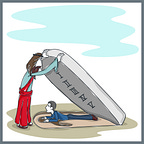
Three years after he came to Jesus by night, Nicodemus comes to him again as the approaching dusk signals the Passover. Whereas Nicodemus had before taken a risk by speaking up for Jesus, now Nicodemus outs himself even further. With Joseph of Arimathea, Nicodemus requests Pontius Pilate’s permission to remove the body of Jesus from his cross and bury him in a virgin tomb. Like Mary had done at his birth, they wrap the LORD in bands of cloth. In his reporting, John mentions a detail. To our eyes it might appear as an extraneous aside. But it reveals the slow, patient labor the LORD endured to birth him: John writes that Nicodemus brought with him for the body of Jesus “a mixture of myrrh and aloes, weighing about one hundred pounds.” Nicodemus carries to the garden a burden that weighted roughly same amount as the beam Jesus carried to his cross. A normal Jewish burial called for only five pounds of spices and oil. If the nard Mary of Bethany lavished on Christ amounted to ten month’s of wages, the myrrh and aloe Nicodemus brings to bury Jesus’ body equals approximately eighty to one hundred years’ wages. In other words, Nicodemus pays a king’s ransom to bury Christ. Nicodemus has done what the rich, young ruler failed to do; he’s given away everything he possessed for Christ.
This makes the last detail all the more revealing. It is the detail John omits. Again, you have to pay attention in order to see. John does not call Nicodemus a believer. Tradition holds that Saint Nicodemus eventually became a believer, was consequently expelled from the Sanhedrin and exiled from Jerusalem. But in the garden, placing the body of Jesus in a virgin tomb— in a cave shaped like a womb, John does not refer to Nicodemus as a believer. John calls Joseph of Arimathea a believer (a secret believer), but he does not so call Nicodemus one.
Apparently, the Risen Christ’s labor was not yet finished.
“Give me understanding that I may live.”
Nicodemus does not receive an explanation of how he can get saved; Nicodemus models the odd and patient way Jesus gives birth to us. More so than understanding, the new birth takes time. The way into the truth that is the life of God takes time. And it takes time because the one in whose image you are being hallowed— the God who is the same yesterday, today, and forever— is infinite. By all means make a decision for Christ. By all means invite Jesus into your heart. By all means repent of your sin and confess that there is salvation in no other name but Father, Son, and Holy Spirit.
All of that is why this table is here.
The table is our altar call.
But!
Nevertheless!
You are not born again by making a decision. It is not an event you can date. You cannot even say that you were saved on a Friday afternoon on a hill outside of Jerusalem because Christ is risen indeed and his Holy Spirit never stops laboring to deliver you into newness of life. The new birth is not the product of a momentary choice. Look at Nicodemus, the new birth just is the sum of your life— one contraction at a time. God does not save us through explanation. God does not save us through information. The LORD our God— this God who hid himself in the darkness of a womb, who spread his arms on the hard wood of the cross, who descended into the silence of the grave and rose again on the third day— this God saves us the way he has always saved us! By showing up! By being present where we least expect him. By speaking a word we cannot yet understand and trusting it to do its work in us while we sleep, while we doubt, while we suffer and worry, while carry our unanswered questions home in the dark.
Doctors confirmed Virna’s suspicions that there was more going on in Martin Pistorius than it appeared. They did so by showing silent, motionless Martin an array of images— every day objects— and inviting him to look at the correct image on command.
The image of an object and an obeyed invitation.
Those were key contractions in Martin’s being born all over again.
And they are for us too.
Image of objects: loaf and cup.
Invitation to obey: Take and eat; drink from this, all of you.
It is literally in the name.
Sacrament.
This is how the LORD hallows you into likeness his Son.
Hear the good news:
You must be born again. You must. The Father will have a suitable bride for his Son. You must be born again. No exceptions. You must be born again. And you will be. Even better, you are no more responsible for your new birth than you were for your first one.
The gospel is a very simple thing.
But the way God loves us into salvation is not simple at all.
Because it is a strange obstetrics.
It looks like ordinary water.
And imperfect words on a sinner’s lips.
And unremarkable creatures of bread and wine.
Over a lifetime.
“All of creation is groaning in labor pains,” say the scriptures.
That includes you.
So come to the table and creep a little closer to your birthday.


