


Psalm 119.23-32
Just before they see him transfigured into glory on Mount Tabor, Peter, having just confessed Jesus as the Son of the living God, recoils at Christ’s prediction of his passion. Peter goes so far as to take the LORD aside and rebuke him, “Far be it from you, Jesus! This shall never happen to you!” To which Jesus responds not with an explanation but with an exorcism. Jesus turns his back on his tempter, exhorting Peter, “Get behind me, Satan!” The blocking is key. Jesus turns his back on Peter. And then, Jesus exhorts Peter by addressing him as Satan. “Get behind me, Satan!” Jesus rebukes Peter, “You are a hindrance to me. For you are not setting your mind on the things of God but on the things of man.”
Jesus addresses the Devil. But there is no figure before Jesus but Peter. Jesus is speaking to Peter, but he is addressing Satan— the voice hiding behind Peter’s voice.
When I first got cancer over a decade ago now and when I finally hit my nadir ten months into treatment and thought I was going to die, I heard a voice. I was standing in front of the mirror, staring at a smooth and emaciated self I no longer recognized, and I heard a voice that was neither external to me but nor was it me.
“You know your faith is all a lie,” the Voice lured me to despair, “It’s a fraud. There’s nothing more beyond this.”
I was the only person in the room.
But I was not alone.
James Baldwin, the author of Go Tell It on the Mountain, was raised in a black Pentecostal church in Harlem. In a 1976 book-length essay of cultural criticism entitled The Devil Finds Work, Baldwin explains what he found so deeply unsettling about the horror film “The Exorcist.”
He writes:
“The film terrified me on two levels. The first, as I have tried to indicate, involved my deliberate attempt to leave myself open to it, and to the extent, indeed, of re-living my adolescent holy-roller terrors. It was very important for me not to pretend to have surmounted the pain and terror of that time of my life, very important not to pretend that it left no mark on me. It marked me forever. In some measure I encountered the abyss of my own soul, the labyrinth of my destiny: these could never be escaped, to challenge these imponderables being, precisely, the heavy, tattered glory of the gift of God. To encounter oneself is to encounter the other: and this is love. If I know that my soul trembles, I know that yours does, too: and, if I can respect this, both of us can live. Neither of us, truly, can live without the other: a statement which would not sound so banal if one were not endlessly compelled to repeat it, and, further, believe it, and act on that belief. My friend was quite right when he said, So, we must be careful—lest we lose our faith—and become possessed.
For, I have seen the Devil, by day and by night, and have seen him in you and in me: in the eyes of the cop and the sheriff and the deputy, the landlord, the housewife, the football player: in the eyes of some junkies, the eyes of some preachers, the eyes of some governors, presidents, wardens, in the eyes of some orphans, and in the eyes of my father, and in my mirror. It is that moment when no other human being is real for you, nor are you real for yourself. This Devil has no need of any dogma— though he can use them all— nor does he need any historical justification, history being so largely his invention. He does not levitate beds or fool around with little girls: we do.”
What truly horrified Baldwin about the movie was the banal manner in which it presented the Enemy as an obviously evil figure external to us. After all, if the Devil slithers up to you like Nagini or suddenly appears wraith-like on a Nazgûl, then resisting his lure is no great achievement. The Devil is different, for the Devil is a self with no substance. The Devil is necessarily dependent on his hosts because he is not a creature. The Devil has neither form nor body. The Devil and his demons are “protean in their emptiness;” that is, they must objectify another— possess them— in order to appear in and act upon the world. As Stanley Hauerwas paraphrases Saint Augustine, “The Devil is angry because he does not exist.”
Thus the Devil’s work is always only parasitic.
Because the Devil has neither substance nor self, he must always wear another as a mask and masquerade as the good. Consequently, the Devil must also always speak in the voice of someone else. Satan’s voice, says Robert Jenson, is always the voice of another— the voice of my friend or my society, the voice of the Volk or the voice of my conscience. In other words, because he has no body, the Devil has no other way to be than to be the whisper in the back of your head. Not only is this insight crucial to how we read the Synoptic Gospels’ account of Christ’s temptations in the wilderness, it is also a fact that complicates how we hear this stanza in the scriptures’ longest chapter.
“Even though princes sit plotting against me,
your servant will meditate on your statutes.Your testimonies are my delight;
they are my counselors.My soul clings to the dust;
give me life according to your word!When I told of my ways, you answered me;
teach me your statutes!Make me understand the way of your precepts,
and I will meditate on your wondrous works.My soul melts away for sorrow;
strengthen me according to your word!Put false ways far from me
and graciously teach me your law!I have chosen the way of faithfulness;
I set your rules before me.I cling to your testimonies, O Lord;
let me not be put to shame!I will run in the way of your commandments
when you enlarge my heart!”
Over the course of this long prayer, the psalmist employs eight different covenantal words to refer to God’s law: Instruction, Testimony, Precept, Statute, Commandment, Judgment, Word, and Promise. Each of those eight words appears roughly twenty-two times in the psalm. Seven of those eight words occur in this fourth stanza alone, and their net effect is to promise to us that attentive commitment to God’s word will protect us from those who plot against us, inoculate us against sorrow, dispel lies and crooked paths from us, and keep us true to God’s will for us.
Of course, if the Devil is a self without substance, a parasite-person, then the psalm’s promise is not the salve it first appears. The Bible is not a guaranteed bulwark against whatever tribulation assails you. Knowledge of the scriptures is potentially perilous, for even as you inhabit the scriptures, an other may inhabit you.
Every year on the liturgical calendar, the Season of Lent begins Christ’s encounter with the Devil in the wilderness, which Matthew, Mark, and Luke all report in their Gospels. Full of the Holy Spirit, Jesus returns from his baptism in the Jordan River where he is immediately led by the Spirit in to the wilderness. Remember, the Spirit is the Spirit of the Son with the Father. Jesus then is not the passive vessel of the Spirit’s leading. The Spirit does not lure him into the wilderness where he suffers a chance encounter with the Devil who seeks to lure him away from the Father’s will. It is the work and will of the Triune God that Jesus ventures into the wilderness in order to do battle against the Prince of Lies. In this way, Christ’s trial in the desert recapitulates the exodus in reverse. Jesus departs the promised land, journeys through the water and into the wilderness, setting out on a path that will end in confrontation with a Pharaoh of a different name. Where Israel proved incapable of faithfulness in the wilderness, Jesus proves to be faithful Israelite.
The exodus motif implies it and Saint Luke states it explicitly: Jesus does not fast for forty days and only at its emaciated end does the Devil tempt him. Rather, from the first day in the desert Jesus engages in extended combat with God’s Enemy, and the hostilities last for over a month. As Luke writes, “And Jesus, full of the Holy Spirit, returned from the Jordan and was led by the Spirit in the wilderness for forty days, being tempted by the Devil.” Across the centuries artists such as Botticelli and Blake, Titian and Duccio, have painted Christ’s confrontation with the Adversary; nonetheless, it is not a scene that can be seen. The Devil is a self with no substance, a parasite-person; the Adversary is not a figure external to— in front of— Jesus.
Therefore the temptations Jesus undergoes arise within him; that is, in the human nature the Son assumes, which is our nature. The Devil’s words are not alien words, spoken outside of Jesus. They instead rise up in Christ’s own consciousness. The Devil is the voice in the back of Jesus’ head. The temptations are the Devil’s temptations, to be sure. But the temptations are possibilities that arise in and occur to Jesus, over and over again, waking and sleeping, as he moves from hunger to the edge of death, during the course of forty days.
“Since you are the Son of God,” the Devil suggests to Jesus, “command this stone to become a loaf of bread.” Next, the Devil shows Jesus all the kingdoms of the world in an instant. Again, how can you possibly picture this if the Devil is a figure external to Jesus? It’s all happening within Jesus wherein the Devil proffers, “To you I will give their glory and all this authority; for it has been given over to me, and I give it to anyone I please. If you, then, will worship me, it will all be yours.” Finally, the Devil transports Jesus to the pinnacle of the Temple in Jerusalem and proves himself a deft exegete of the scriptures. “Since you are the Son of God,” the Devil reasons, citing Psalm 91, “throw yourself down from here, for it is written, “He will command his angels concerning you, to protect you,” and “On their hands they will bear you up so your foot will not be dashed against a stone.”
Notice, none of these three temptations are general temptations. The temptations are unique to Jesus. They apply specifically to the vocation the Father has given him. Rather than distribute the manna that is his broken body, Jesus does have the power to turn stones to bread and thereby feed more than a multitude. When he is enthroned upon his cross, Jesus will receive all authority over every nation and tongue. When he falls down into death, the Son of God nevertheless will be born up to the Father’s right hand. The Devil’s temptations in the desert are temptations unique to Jesus. They all point to ends Jesus will accomplish. The Devil’s lure is to tempt Christ to take up his task in ways that are false to his calling, “Get behind me, Satan!”
Once again, the Devil is a self with no substance.
Satan necessarily works parasitically.
Accordingly, the Devil comes to Jesus in this way with these three temptations because these are the questions in Jesus’ own mind. The Enemy speaks within Christ’s thoughts with Christ’s own thoughts. The temptations the Devil presents to Jesus are merely the possibilities that have occurred to Jesus in his human nature— in our nature. The Devil is not obviously evil, after all. The Devil is the angel of light squatting in Christ’s own thoughts, attempting to turn those very thoughts into a lure that will lead Jesus away from the cross. Don’t forget— the prospect of the cross does fill Jesus with dread. And the Devil strikes at that point of vulnerability, suggesting alternate ways to fulfill his vocation, ways that Jesus himself has considered.
Jesus has thought about fulfilling his Mother’s song by turning stones into bread. Jesus has dwelt on establishing his lordship by means other than self-offering. Jesus has considered proving his identity rather than wait for the Father to raise it up from the dead. The Enemy speaks within Christ’s thoughts with Christ’s own thoughts.
Which means, the Devil can quote the scriptures astonishingly well because the Devil’s knowledge of the scriptures just is Jesus’ knowledge of the scriptures, used against him.
Not quite ten years ago, I sat at my desk in my office on my computer. I was slogging my way through my inbox when I heard a nervous rap on my door. I looked up and through the window in my door and saw a face I recognized but whose name I couldn’t place. He was about my age. He had a little girl in the fours and fives class in the church preschool. And he came to the early service nearly every Sunday, sitting in last pew on the pulpit side. I opened the door and welcome him into my office and ushered him to a chair. He wore a blazer over a polo shirt and hightop sneakers with his jeans. I sat across from him.
He must’ve seen me struggle to recall his name, “It’s Brett.”
I nodded.
“Brett, that’s right. So Brett, how can I help you?”
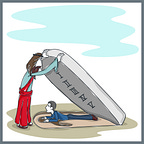
Maybe it was the prospect of speaking his problem aloud but the color suddenly flushed from his face. He doubled over, leaning with his elbows against his knees. I reached for my trashcan; I thought he was going to throw up— it wouldn’t have been the first time it’s happened in my office. But then I heard him crying in a quiet, child-like tenor. He could’ve been hiding under the bed instead of sitting in church.
I put my hand on his shoulder, “Take as long as you like. Everything’s going to be okay.”
“I don’t think so,” he whimpered, “I used to think so, but I don’t think so now.”
Eventually he sat up, wiped his blood-shot eyes, and took the tissue box in my hand.
“How can I help you?” I asked again, “What’s troubling you?”
He took a deep breath, like he was about to plunge into cold, deep water.
He said, “I used to be a gambling addict.”
Before I could reply, he corrected himself, “I mean, I am. I am a gambling addict.”
“I see,” I said, “So that’s your problem?”
“No, not exactly,” he answered, “My problem is that my gambling problem was in my past. And then I got married. And I didn’t tell her about it. She has no idea.”
I nodded.
I was about to release him from what I thought was his burden of guilt, but he cut me off to clarify.
“I had a gambling addiction and and then I got married and I didn’t tell her and then…and then the MGM went up across the river.”
Like the jump scare you know is a moment away, I sensed where this was headed. Suddenly I felt like I was the one about to puke.
“She thought I was going to the gym this morning.”
“How much did you lose?”
It took him more than a moment to muster up the courage to tell me.
“All of it. Everything we have.”
I got the sense he wanted someone to sit with him in his amazement more so than he wanted absolution. I nodded. I kept silent. I waited for him.
When he did speak, he confessed:
“I thought it was all behind me. I thought I had it beat. I mean— you know, pastor. I come to worship, religiously. I never miss a Sunday. I gave my addiction over to Jesus. And I’ve completed more Bible reading plans than you would believe. I truly believed that with God I had overcome my problem. I even memorized verses; I clung to them: “I can do all things through Christ who strengthens me.” and “If anyone is in Christ, he is a new creation.” And my favorite, “He who is in you is greater than he who is in the world.”
He started to weep again.
Finally he said, “I saw it across the river this morning. And it was like a voice in the back of my head said to me, “God is faithful, and he will not let you be tempted beyond your strength…” It’s like all these scriptures I’d committed to memory in order to protect me were turned against me.”
In his essay “Evil as Person,” Robert Jenson writes:
“There is a spirit afoot who has no self…The Devil often speaks even with the voice of God— above all with the word of God. For in his protean presence, he mimics God’s omnipresence. We hear him everywhere, and just therefore he can speak not only with society’s voice or our inner voice; he can mimic God’s voice with God’s own word.”
The Devil finds work in our knowledge of the word.
“For it is written in the psalms,” Satan says to Jesus, “He will command his angels concerning you, to guard you” and “On their hands they will protect you.” The Devil speaks within Christ’s thoughts with Christ’s own thoughts. When the Devil speaks, Jesus hears his own knowledge of the scriptures as the Devil wants him to hear it. No matter what the plain reading of this psalm might suggest, prayer and fasting and scripture do not protect you from the Adversary. God’s law, God’s precepts, the LORD’s statutes, his word and commandments: they are not a refuge for you from the wiles of the Devil. The Prosperity Gospel is not gospel. In fact, Matthew, Mark, and Luke straightforwardly show that the more like Christ you become— the more of his word you commit to your heart, the more closely you walk in his path, the more steadfast your piety— the more vulnerable you are to that which is against God.
When Satan speaks, Jesus hears his own knowledge of the scriptures as the Devil wants him to hear it. So what (and remember the Spirit led him there precisely for this confrontation) is Jesus doing in the wilderness? Likewise, do not forget that this is a clash Jesus engages for us.
What is Jesus doing with the Devil in the desert for us?
As the church father Gregory of Nazianzus summarized the incarnation in the fourth century, “That which is not assumed is not healed.” That which in human nature is not assumed by the Son is not healed. And to be in Adam, to have our nature broken by the Fall, just is to have that Voice in our head pulling us in directions away from God’s will for us. Just so, Jesus journeys into the wilderness in order to draw the Devil out of the human nature he has assumed. Jesus confronts the Evil One for the purpose of surfacing the lies Satan had sown into our nature. In the wilderness, Jesus does not so much expose a pattern of how the Devil tempts us. In the wilderness, Jesus begins the work— a work he completes upon a hill— of freeing our nature; so that, we can know and do the will of God. Which is to say: in the wilderness, Jesus begins his work of transfiguring human nature. Put differently, this long psalm about the law is not true until Jesus walks into the wilderness and climbs upon the cross.
“It’s like all these scriptures I’d committed to memory in order to protect me,” Brett exclaimed, “It’s like they were turned against me.”
I listened to him until his remorse and dismay turned to self-justification, “When are you going to tell your wife? How will you break the news to her?”
“I can’t tell her!” he said, like I’d just suggested gravity doesn’t exist, “What could I possibly say to her?”
I tried to offer a gentle smile at the stupidity of his position.
“Never mind that’s she going to find out the next time she tries to use her debit card,” I said, “Simply tell her what you told me just now. And then ask for her forgiveness.”
“Forgiveness?! Are you insane, preacher? Look, I love her, but she’s not Jesus Christ. There’s no way she can forgive me.”
That which is not assumed is not healed. But! That which has been assumed has been healed. We must not make sin appear more compelling or true than Jesus Christ. And we must not take the voice in the back of our head more seriously than the voice that claimed us at the font. That which is not assumed is not healed. But that which has been assumed is healed.
And Jesus has assumed all of it.
He has assumed the whisper in the back of your head. He has assumed the Voice in front of the mirror. He has assumed the scripture verse twisted into a lure. He has gone into the wilderness of our nature and faced the Enemy down— not as a teacher demonstrating technique, not as a guide showing us it can be done if we only try harder. No. He has gone farther than to give us an example. He has done more than provide us a patter. He has removed the Principalities and Powers from Adam’s nature.
And that is the nature we are given in baptism!
The Devil tempted Jesus with stones and temples. The Devil tempts us with the lie that we cannot live the life of Jesus. What has been assumed has been healed; such that, now the temptation which arises in us is to live as if this has not happened and is not accomplished. But the gospel is not that Jesus has freed you from the obligation of being a Christian. And grace is not the assurance that it’s impossible to live as Jesus.
Those are lies.
Those are lies spun by Satan.
The Devil tempted Jesus to prove he’s the Son of God. The Devil tempts you to believe the Son of God fulfilled nothing more than your pardon. The Devil tempts you to believe Jesus has healed none of the gone-wrongness in the world, as if the wilderness was not been won.
“Are you insane, preacher?” Brett nearly hollered at me in disbelief, “There’s no way she can forgive me.”
I leaned forward in my chair. I took his hands in mine. And I forced him to look me in the eyes.
“The Bible not protecting you from your addiction— that’s one lie of the Devil,” I said, “But the notion that your wife can’t forgive you as Jesus forgives you— the notion that she can’t be as Jesus to you? That’s another of the Devil’s lies.”
Hear the good news:
Jesus journeyed into the wilderness.
And Jesus won.
God forgive us for acting as though Jesus did not beat the Devil!
That which he assumed— that which he took to the desert; that which he carried to Calvary; that which he bore in his body upon a tree— is healed.
It was accomplished.
The wilderness was won.
The cross was not a defeat. The tomb did not hold him. And on the third day— on the third day— the nature that walked out of that garden is none other than the nature you were gifted at the font. That is what the Spirit is at work in you to live.
So when the Voice comes…
And it will come.
He came for Jesus— he came from within Jesus.
And he will come for you.
He came for Peter on the road to Caesarea Philippi. He came for me in front of a mirror on the cancer ward. He came for Brett that morning before he knocked on my door. And he will come for you.
The Devil finds work still.
Though he is defeated, the Enemy remains a self with no substance. Therefore, when he comes for you, he will come wearing the face of scripture. He will come speaking in the cadence of your own best judgment. He will come rising up in the very piety you thought would protect you.
When he comes, you do not face him alone.
Nor do you face him unarmed.
You can confront the Devil as one who has been baptized into the One who already engaged him and won. By water and the Spirit, God has clothed you in more than Christ’s righteousness. The LORD has baptized you into the victory of Jesus. That which has been assumed is healed! The wilderness that was won is in the water with which we baptize.
That which has been assumed is healed.
And you have been given that nature.
You have been given that victory.
You have been given the little word that fells him.
It is yours to live.
So to every voice that is not his own— every lie dressed in the church’s clothes, every whisper that your faith is fraud, every falsehood that suggests forgiveness is impossible, that the way of Jesus is a path for better people than you— you can say, “Get behind me, Satan!”
Or, instead of saying “Get behind me” you can simply come forward.
To the table.
Taste and see.
That which has been assumed is healed.
And that which has been healed is given.
Free of charge.
The One who refused to transform stones offers you bread that is his body.
In loaf and cup, you do not merely receive forgiveness here.
You receive your self.
Your healed self.
The self Adam lost and Christ won back.
This is what God presses into your hands as bread.
This is what God pours out as wine.
The Devil finds work.
So come forward.
Take and eat.
And let Jesus have your back.


