

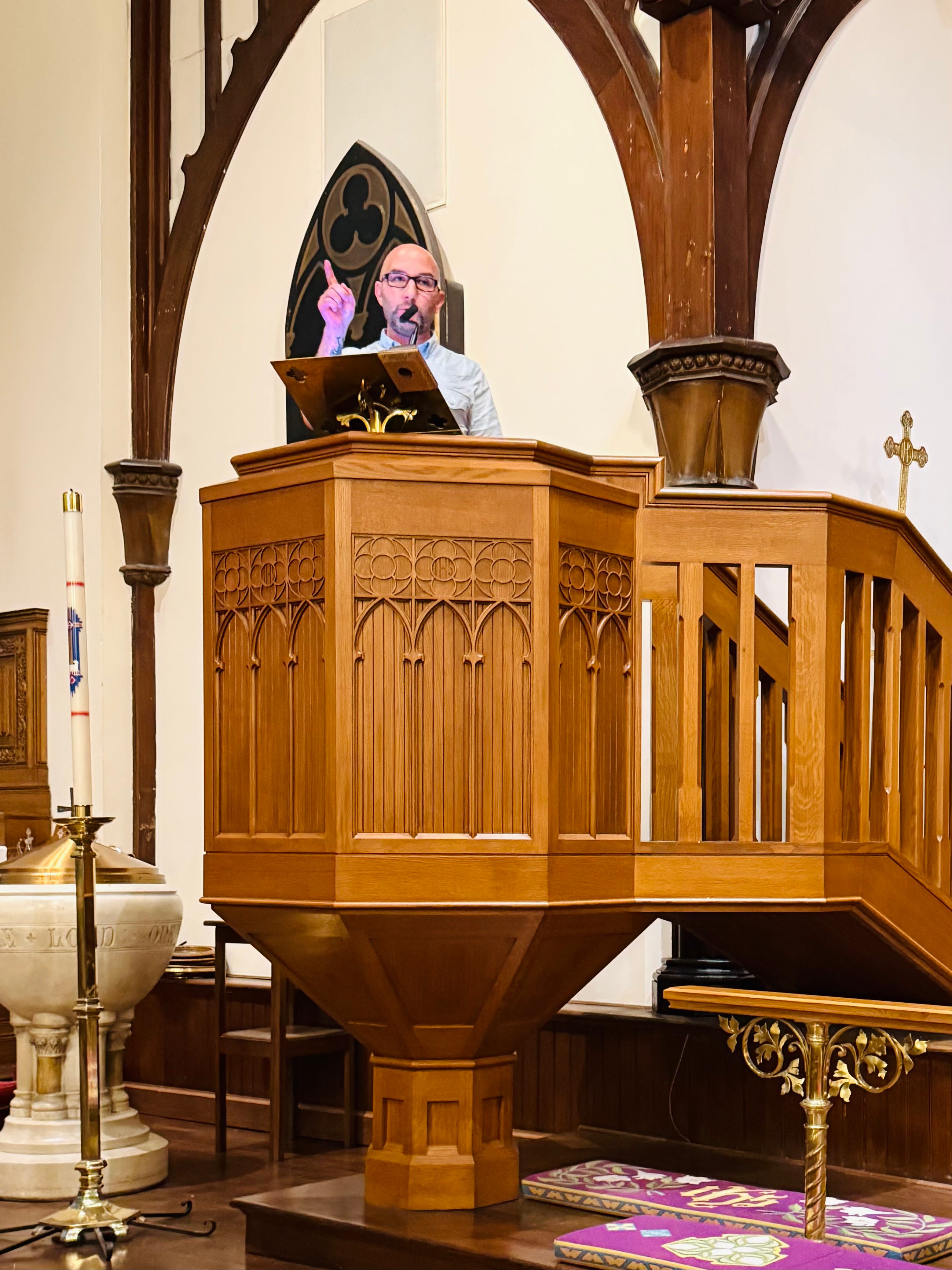
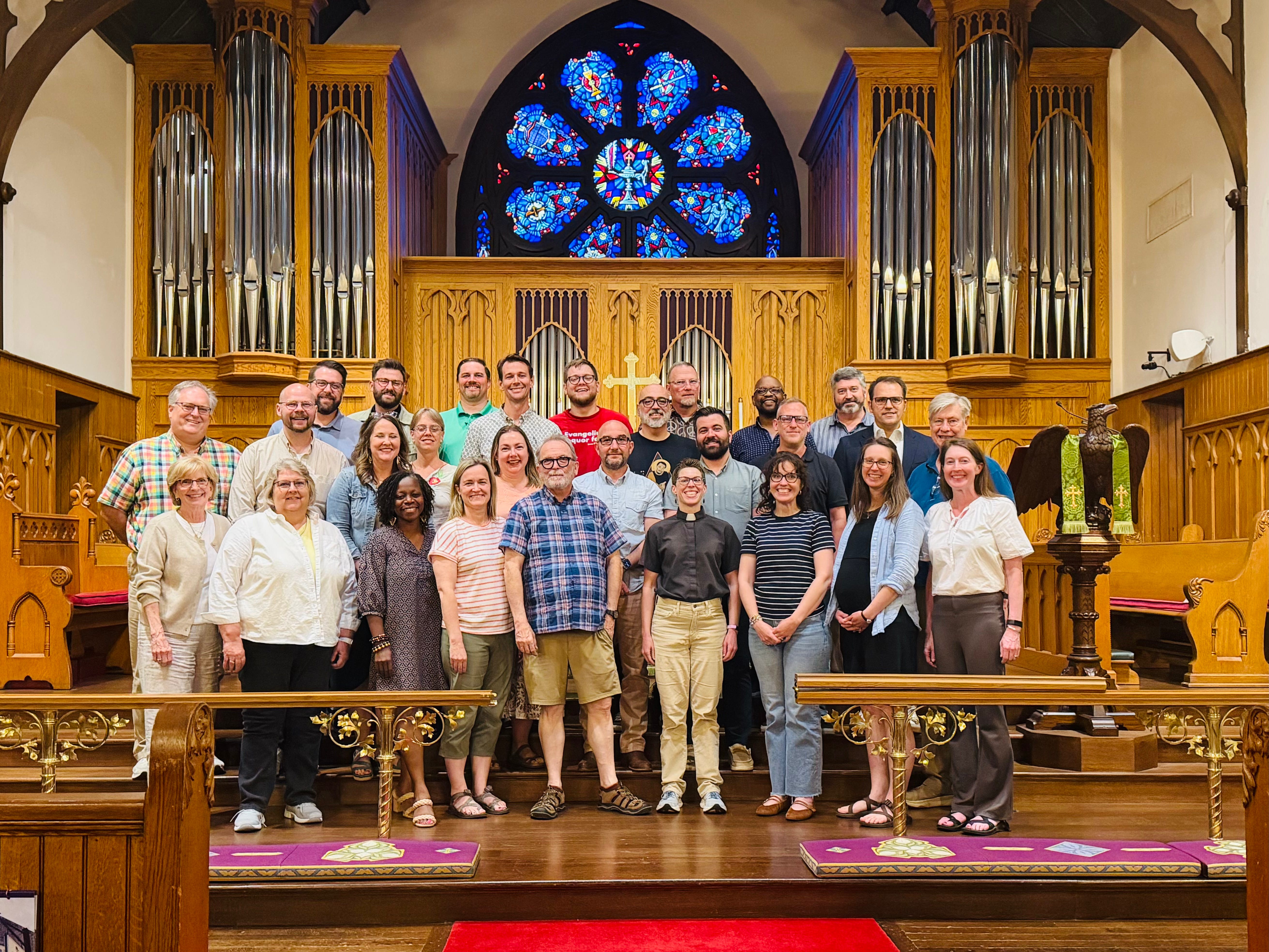
Here is my sermon for the close of the Preaching Slam for the Preachers Project gathering in Charlottesville at Christ Episcopal Church. The theme was the “Foolishness of the Cross” and my assigned text was the Song of Moses.
Deuteronomy 32.1-9
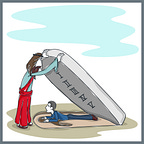
In the Gospel of Matthew, just before our plot to kill him finally ensues, the LORD Jesus tells his penultimate parable. A Master goes away on a long journey, Jesus says. Upon departing, he gathers three of his servants and entrusts a portion of his wealth to each of them. To one servant, the Master gifts roughly eighty-two years worth of income. To a second servant, the Master bequeaths a little less than half. A third servant receives a single talent, still an enormous sum— an amount befitting not a slave but a child.
Every preacher and all those who suffer preachers already know how the rest of the story goes, or at least you think you do. The slave who was graced with five talents immediately puts his money to work. What this work entails Jesus seems disinterested in telling us. When the Master returns, the slave rushes to him with the bold confidence of a child and says, “Listen, you gave me five talents, I’ve made five more.” And the Master replies, “Well done, good and faithful servant, enter into the joys of your LORD, enter into the happiness of your Master.” Likewise, the second servant, the one who was given two talents— two decades of wages, a huge sum— doubles it, comes back when his Master returns home and says, “Listen, you gave me two. I doubled it.” And the Master says once again, “Well done, good and faithful servant, enter into the joys of your LORD.”
Finally, the third servant, who was given one talent— still a huge, life-changing sum, digs a hole and he hides his gift in the ground. We do not know what the other two servants did with their talents, but he does not know what to do with his inheritance. So he buries it. And when the same Master returns, catching him, as it were, in the act of not acting— in his sin or his failure or his unfaith, the slave justifies himself, “Master, I know you are a harsh man who reaps where you do not sow and gathers what you did not scatter. And so for fear that I would lose it, I hid it in the ground and have kept it safe, and now I return it to you. Here is what is yours.”
Notice—
He does not say, “Here is what you gifted me.”
He says, “Here is what is yours.” Despite the gratuitous, extravagant gift he still thinks of himself as a slave. This third child has not yet shaken free of his own projections onto his Master. That is, he has not received a promise by which to know that he himself is his Master’s portion and prize. He fails and then he fears because he has not been freed by a word that reveals his Master to him.
Truly.
On the precipice of the Promised Land, after forty years in the wilderness— a generation of being tested by trial and forged into faithfulness— after forty years of God getting the Egypt out of Israel (or trying to), the LORD appears to Moses and Joshua at the Tent of Meeting in a pillar of cloud. Just as a golden calf followed immediately after the theophany on Mount Sinai, the occasion for the LORD’s glorious appearance on the east bank of the Jordan River is to inform Moses not only that he is about to die but that the people whom Moses has shepherded for an insufferable amount of time will soon, after his death, adulterate themselves with other gods and break the covenants the LORD has only recently made with them. In other words, they will forsake their Master who would not forsake them to Pharaoh.
The pillar of cloud is glorious; the message it delivers is devastating.
You are going to die.
And your people are going to fail.
God says at the Tent of Meeting.
Rather than a benediction, Moses receives a prophecy of sin and idolatry. Whereas at Mount Sinai the LORD appeared amidst Israel’s rebellion, at the edge of the Promised Land the LORD now appears in advance of their unfaithfulness. As a providential, preemptive strike against his people’s sin, the LORD gives Moses a word to hand over to them. Where the written Torah is to be kept in a clay jar beside the ark— where it can be forgotten as surely as a Bible on the shelf— the word which the LORD gives to Moses is meant to burrow into his people’s hearts and memories through their ears. “Write down this song,” the LORD commands Moses, “and teach it to the people of Israel. Put the words in their mouths; so that, this song may be a perpetual witness for me.” Just so, the song will simultaneously function as a witness against the people. While God is “the Rock,” upright and perfect, his people by contrast are “warped and crooked.” Even worse, we are nabal— not merely “foolish” but living as people who are not a people; that is, we are indistinguishable from the ungodly and therein do we “disrespect the LORD” who made us his “portion” and “allotted heritage.” Much like the song on the lips of the crucified Israelite, the song of Moses nevertheless concludes by making a promise not only of the vindication of the LORD’s justice but the merciful salvation of his people.
In other words, in advance of our failure and unfaithfulness, God hands over an audible sacrament that is not ultimately about our sin but about his identity.
You are going to fall short.
And you are not getting out of life alive.
In light of these facts:
The LORD gives a word; so that, we might know who he is.
“Master, I know you are a harsh man.”
But he never replies, “You are right. I am a hard, harsh Master.”
For that matter, notice. The Master never asks for his money back. He never asks for a return on his investment, not from any of the three. He simply gives the dirt-covered talent to another servant; its lack of interest is of no interest to him. He does not care about the treasure he gave to his servants. He cares about— he takes care for— his servants to know him.
A few years ago, in the middle of a sermon series on the Sermon on the Mount, just after the Sunday in which I preached on Matthew 5.43-45 (”Love your enemies, pray for those who persecute you”), a relatively new parishioner— a bit younger than me— asked to meet with me. Knowing his background in the military, I expected him to push back against a word I had recently handed over to him, a word he felt was a witness against him.
I ushered him into my office. I closed the door. And I gestured towards the faux leather sofa. He walked over and stood in front of it. He did not sit down. Instead he looked down at the floor. Then he closed his eyes, which were already tearing. And he said, “I need you to know, I don’t actually work for the State Department.”
Then he fell down into the sofa and proceeded to confide in me. He told me about enlisting out of high school after 9/11. He told me about the black-ops work we pay him to do. He told me that though he had grown up in the church it was only in light of the Sermon on the Mount that he had recently begun to reckon with the fact that his lethal skill might also be deadly sin. After confessing some of his kills, he finally told me about a cat in Syria that he killed on accident, the memory of which at once caused him to fall apart weeping.
When his sobs ebbed, I said, “I don’t think it’s about the kitten.”
When he finally wiped his eyes and looked up into mine, I said to him, “The LORD is not the harsh Master you think him. And he’s given me a word to speak over you: “Daniel, remember your baptism. In the name of Jesus and for Christ’s sake, all your sins— and they are that— are forgiven.”
He had gone to church his whole life, he said. But he had not yet known his Master. The song somehow had not been sung to him.
In the Book of Acts, a man crippled from birth sits on the streets of Lystra and listens intently as Paul and Barnabas preach. Seeing him, Paul discerns the strength of the lame man’s faith. The apostle exhorts the crippled man in a loud voice, “Stand upright on your feet.” Luke reports that immediately the man “sprang up and began to walk.” Just as quickly, the bystanders begin to shout in their Lycaonian language, positing Paul and Barnabas as avatars of their pagan deities, ”The gods have come down to us in human form!” The denizens of Lystra then identify Barnabas as Zeus while Paul, they surmise from his role as chief speaker, must be Hermes. According to Luke, all of Lystra kicks into cultic gear.
But Paul emphatically rejects the honor: “Friends, why are you doing this? We are mortals just like you.” And then Paul announces the purpose of their travels, “We are here to speak the gospel to you; so that, you may turn from such barren deities to the living God.”
Lost in our distinctions between law and promise, obscured by our prescriptions for proclamation, in our attempts to rightly divide the word of truth we too often neglect to consider a more basic question, “What is the gospel meant to do to those who hear it?” According to Paul, before it quickens and vivifies, before it accuses and absolves, before it kills and makes alive, the preached word introduces its hearers to the true and living God over and against the barren deities.
There are many who do not believe in God who will suddenly one day believe in god. After all, we are all going to fail; none of us is getting out of life alive. When one or both of those things happen, suddenly people who do not believe in God discover themselves believing in God. Yet the god in whom they will suddenly believe— the god against whom they will rail and reject— is not actually God.
But the only way they can know the true God— the God who is not a harsh Master— is through you; or rather, through God’s prevenient, preemptive placement of you.
At:
Chattanooga, TN and Peoria, AZ
Floris and Trinity UMC
Elysburg, PA and Dilworth and Osakis MN
Havre, MT and Sanford and Salisbury, NC
Bonney Lake, WA,
And Baltimore and Pittsburg and Denver.
Michigan and Iowa
And York, Pennslyvania.
“I just don’t know that I can believe that,” Daniel said to me, his words escaping from his tightly suppressed sob.
“Of course you can’t believe it,” I said, “You need a preacher. Come back on Sunday. Or come by any day, and I’ll hand it over to you again. It’s like a song— God’s determined to get it in your head and your heart.”
“Seems like a ridiculous way for God to deal with the world I’ve seen.”
“Yeah. It is.”
When the Master returns to his servants, he does not ask for his money back. He says, “Enter into my joy.” He is not interested in a return on his investment. He means to make us equals, for you are his portion and prize. But how could you possibly know such a thing apart from a preacher?
The last time the word darkness appears in the Gospel of Matthew is when Jesus is on the cross. Darkness descends over the city, and in the darkness Jesus cries out, “My God, my God, why have you forsaken me?”
The true God is not a harsh Master.
He is the servant we banish because he was worthless.
He is the servant who suffers our failure and infidelity.
He is the servant cast into outer darkness so we are not alone.
But no one could possibly discover God in the dark without a word.
From someone who has been found by him.
I weary of the way cancer constantly intrudes upon my identity. Nevertheless, I’ve got a vested interest in you. Take it not from Jason the Preacher but from Jason the Patient. The song of the Risen Son on your lips really is a matter of death and life. This would be a horrible and heavy burden were it not for what the LORD says before he gives Moses the song.
“I will be with you,” the LORD promises those who proclaim him.
The good news is that you are not the good news.
The Word works what it says not how well you say it.
As the archangel says to Ransom in C.S. Lewis’ Perelandra at the close of the cosmic battle:
“Be comforted. It is no doing of yours. You are not great. Be comforted, small one, in your smallness. He lays no merit on you. Receive and be glad.”
Like Moses with his people at the edge of the Promised Land, we now part ways. Leave from here and enter into the joy of your Master. Small ones in ordinary place, preach the same old song of the gospel. And be comforted— its doing is no doing of yours.
We’re fools to think otherwise.


