


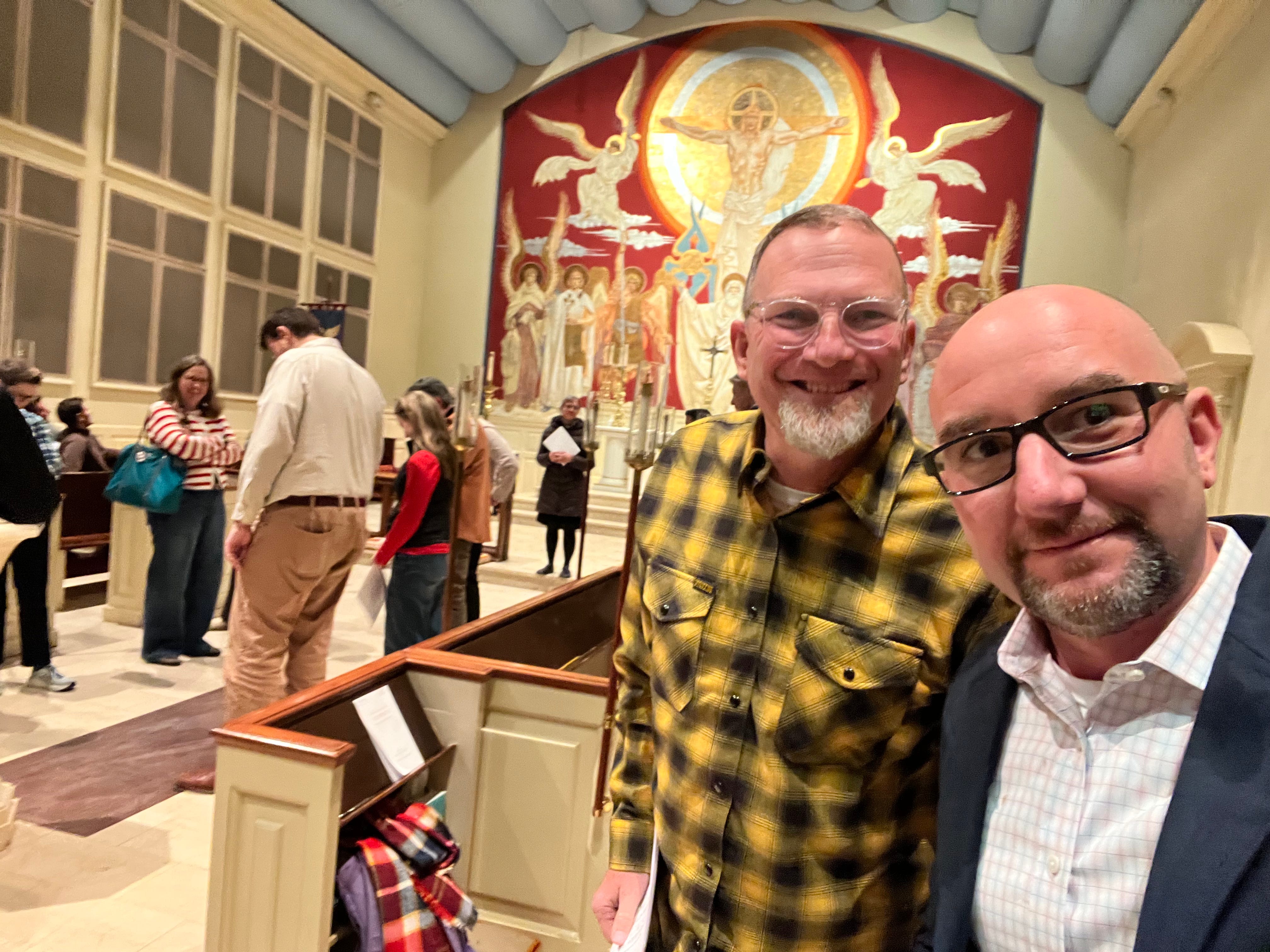
I am in Memphis at St. John’s Episcopal Church for our second gathering of the Iowa Preachers Project. Here is the sermon I offered for the opening worship service.
Galatians 4.8-20
The theologian Stanley Hauerwas preached for me on Christ the King Sunday more than five years ago. The Gospel passaged assigned by the lectionary that year was John’s account Christ’s encounter before Pontius Pilate. During his sermon, Hauerwas quoted Dietrich Bonhoeffer and then made the comment that the problem with Donald Trump is that he is such a boor. I stood next to the preacher in the narthex after the worship service.
After most of the congregation had petered out of the pews, a parishioner sidled up to Hauerwas. He motioned for his children to proceed into the fellowship Hall ahead of him. So they wouldn’t hear what he had to say to the stranger.
Peter complained, “I didn’t much like what you had to say, preacher.”
At first Hauerwas looked perplexed by the comment. Then I saw his black eyes become like live coals.
“Liked it?!” he hollered in his squeaky Texas warble, “Liked it? I don’t give a shit whether or not you liked it. That was Jesus Christ, the Word of God.”
“That was God’s Word?” he asked skeptically.
And Hauerwas turned the ire in his eyes towards me, as if to condemn me for my poor catechesis of my congregants.
Then the preacher took a step closer to his hearer and with deadly seriousness, as though it’s a matter of death and life— it is, he replied, “We preach the Word of God from the Word of God about the Word of God; so that, the Word might take flesh.”
I could tell from the pained look on Peter’s face that he was about to push back, but Hauerwas shook his head, astonished, “Liked it? Would you wander into a hospital delivery room and gripe at some young woman in labor that you didn’t like her technique?”
A thousand years ago, Bernard of Clairvaux preached a sermon for the Second Sunday of Advent on the “three comings of Christ.”
Bernard writes:
“We know that there are three comings of the LORD. The third lies between the other two. It is invisible, whilst the other two are visible.
In the first coming he was seen on earth, dwelling among men…In the final coming all flesh will see the salvation of our God, and they will look on him whom they have pierced…In his first coming, our LORD came in our flesh and in our weakness; in his final coming he will be seen in glory and majesty. In this middle coming, he comes in spirit and in power, but this intermediate coming is always hidden.”
According to Bernard, what we tend to call the Second Coming will not be the arrival of a heretofore absent Christ. Jesus is always coming to us, yet his coming is always hidden because he comes to us through us. That is, he comes through proclaimers of the gospel. In this meantime, Christ “appears” only through your laboring. He comes again and is present to his people just as you bring his Word to bear in the world. In other words, believers can become like Christ only to the extent that Christ’s preachers first become like his Mother, Mary.
“My little children, for whom I am again in the pangs of childbirth, until Christ is formed in you.”
In the sixth century, the ecumenical Council of Orange established it as Christian dogma that salvation is God’s work alone; unfortunately, the Apostle Paul will not easily abide our hard and tidy distinctions between grace and effort, between proclamation and participation, between God’s work and ours. And if that is not inconvenient enough, Paul refuses to let preachers off the hook. Paul does not say, “My little children, whom I have addressed.” Paul does not say, “My little children, for whom I have provided prophetic critique.” Paul does not say, “My little children, who once understood the doctrine of justification but now do not.” He says, “My little children, for whom I am again in labor— again in travail— until Pilate’s victim is formed in you.”
Just so—
For Paul, preaching is not finished when the sermon has been spoken. The gospel is not complete once the gospel has been announced. Christ is not complete simply because his name has been named. Jesus has to take to form. And that formation, Paul insists, involves labor— painful, costly, vulnerable labor— on the part of the preacher himself.
Although Paul only explicitly mentions Mary once (and even then not by name), he alludes to her repeatedly in his epistles when he describes the nature of proclamation, the work of redemption, and the mystery of the church. Too often we treat Paul as though his primary image for the gospel is that of the courtroom, but more so Paul reaches for obstetrical images. Again and again, he turns to the language of womb, pain, blood, patience. And time. Here in his letter to the churches of Galatia, only fifteen verses after he has named the LORD’s mother, Paul takes up her voice and speaks to the children who perplex him— like all children do. He speaks as a mother who can no more will the birth to happen instantaneously than she can walk away from it.
The Council of Ephesus declared Mary the Theotokos in 451 AD. But the Letter to the Galatians ventures an even stranger, more astonishing claim. Paul declares you all to be theotokoi— mothers of God. Quite simply, Paul confesses that his labor is like Mary’s in that the LORD Jesus is being birthed through him. Paul admits that this labor is long and painful, for Christ (once again!) needs to be born through him. And then Paul nurses them with the milk of the Word until they mature. And don’t lose sight of the fact that Paul makes this claim about preachers to people for whom he has already preached. From the womb of his mouth, Paul has already birthed Christ into them. And now he has to do it again.
The language is as odd as Christ’s encounter with Nicodemus.
I am in labor with you again.
You have to be born again again through me.
This tells us something crucial about preaching. Namely, proclamation alone does not exhaust pastoral responsibility. The gospel does not absolve the preacher from continued vulnerability. Faith can be born and then deformed. The justified can live unjustly. Christ can be announced and yet remain unformed. Thus, preaching is not over once the sermon is finished. So much of homiletics focuses on the discrete preaching act, the object of the sermon, the moments in the pulpit.
But Paul suggests the work does not end there.
In his “Lectures on Homiletics,” Dietrich Bonhoeffer warned his students at Finkenwalde that the sermon is not finished when the last word is spoken. The time after the sermon belongs to the sermon too. And for the preacher, Bonhoeffer says, that time is particularly dangerous.
Why?
Because after the sermon, we are exposed.
We are tempted toward vanity, “Did it land? Did they like it?” We are tempted toward despair, “Was it enough? Did I fail? Am I truly called?” We are tempted toward control, “What do I need to say next to fix this?” And we are tempted toward withdrawal, “I’ve done my part.” Bonhoeffer names one especially revealing sign: the preacher who leaves the pulpit utterly depleted— emptied in soul, not just tired in body. That kind of depletion, he says, may signal that something went wrong, that the preacher does not understand the task. God depletes himself in preaching, Bonhoeffer insists, not the pastor. When the preacher is exhausted at the level of their being, it may be because he has mistaken himself for the offering. She may have misunderstood herself as the speaker. The preacher might falsely believe they are the ones who make the Word work.
Paul refuses that confusion.
He does not offer himself as a replacement for Christ. But neither does he retreat into detachment. He does not say, “Well, God will sort it all out.” He goes into labor again. Again, this is why it is absolutely critical that we are not living in Christ’s absence but in his hidden presence. It matters for preachers because it means that Christ is not waiting for us to summon him. He is already here. The question is not whether Christ will come. The question is how he will be formed. And formation, Paul insists, takes time. It takes labor. It takes pain. It takes something like pregnancy.
That Christ the King Sunday all those years ago, as Peter the parishioner walked away, Hauerwas turned to face me and grabbed my hands.
“We’ve got to pray for him.”
“What now?”
He nodded, “Maybe if we labor a bit more, Jesus will be born.”
The early church understood this far better than we do.
In his Ecclesiastical History, Irenaeus of Lyons includes a letter from the second century describing the persecution of Christians in Vienne and Lyons. The central figure in the letter is a young slave woman named Blandina. Brutalized in the arena, suspended on a stake, she becomes— astonishingly— the site where others behold Christ. “Through the sister,” the letter says, “they saw with their outward eyes him who was crucified.”
The most striking moment comes later in the letter. Some former Christians— not ones who had been beguiled by false preachers, as in Galatia— but had denied their faith under torture or duress. The letter refers to them as “stillborn and miscarried.” And yet, through the faithful witness of Blandina unto death, they repented and returned to the faith. The letter describes this return in the language of conception and birth, “Those once dead were made alive; those once miscarried were conceived again.” And then the author adds, “There was great joy over them in the Virgin Mother.”
In the Virgin Mother.
That is, the church.
The church is virgin because Christ alone is her source.
The church is mother because Christ is born through her.
This is not sentimental imagery. You have to be conditioned to take it as a metaphor. It is costly imagery. The Virgin Mother does not control outcomes. She can miscarry. She can lose children. She can weep. But she does not cease to be a womb. Paul knows this. That is why he reaches later in chapter four for Isaiah fifty-four when speaking of the church, “Rejoice, O barren one.” The barren woman becomes mother not through technique or success but through God’s strange, cruciform generosity. Christ’s own death opens the womb. Baptism into that death becomes birth into life.
Which means that preaching is always risky.
When you proclaim Christ, you open a womb. Something may be conceived. Or not. Something may be formed. Or distorted. Something may come to term. Or fail.
And none of this can be managed!
Certainly not from the pulpit.
This is why our text tonight refuses to let us imagine preaching as a finished act. Paul’s labor is not about securing results. It is about remaining faithful within the process by which Christ is formed— or not— in a community. The God who chose not to be God without us likewise elects not to save us without us— not because God lacks power, but because God refuses to save without communion. Just as grace does not rescue you from the burden of being a Christian, the gospel does not eliminate participation.
He calls theotokoi.
As Mordecai tells Esther: deliverance will come from somewhere— but whether it comes through you matters.
On Christmas Eve, after the sermon, at the end of the seven o’clock service, a parishioner came up to me, visibly angry.
Mothers don’t always beget the children they would choose.
“I can’t believe you had the gall to preach about Donald Trump on Christmas Eve!”
“Donald Trump?” I said, surprised, “I didn’t mention him at all. Why in the world do you think I preached about the president?”
“What you said about King Herod naming his palace after himself and Caesar putting his name and face on buildings and coins. You were talking about Donald Trump!”
“I didn’t intend for that to be a word about Donald Trump, but isn’t interesting that you heard that as a critique of him. The Holy Spirit must be working on you.”
Hear the good news:
Christ is not waiting offstage for better conditions or better preachers, which means you don’t need to be waiting for the perfect call or congregation.
Jesus is already here, in this middle coming— hidden, insistent, living— pressing to take form again in frail people with weak, imperfect words.
The miracle is not that sermons succeed.
The miracle is not that a congregation finally “gets it.”
The miracle is not that the preacher walks away feeling justified by applause or absolved by exhaustion.
The miracle is that God keeps entrusting himself to laboring bodies and trembling voices, to churches that can miscarry and still somehow conceive again, to preachers who do not control the birth but refuse to abandon the womb.
Hear the good news:
You are not responsible for making Christ happen. But you are responsible for laboring with your people long enough that Christ might be formed. This is the strange obedient freedom of the gospel for preachers. You do not have to manufacture results. You do not have to protect yourself from vulnerability. You do not have to flee the dangerous time after the sermon. But you do need to stay. You do need to pray. You do need to suffer the slow work of God.
In that patience— against all reason— life stirs.
Hear the good news:
The Word you preach is not inert. It does things. It unsettles Herods and exposes Caesars. It provokes anger you did not intend and repentance you could not plan. It names kings where you never said their names and comforts sinners you never knew were listening. That is not because you are clever or courageous, but because Christ insists on being born where he wills— sometimes in those who resist him most.
Hear the good news:
Labor is not failure.
Pain is not proof that nothing is happening.
The church’s groans are not signs of absence but of pregnancy. Where the Word is spoken and borne and suffered, Christ is coming— again and again—through you, mothers of God.


